The items of militaria shown below can be viewed in our on-line shop complete with full descriptions, photographs and prices.
|
| Admiral Horatio Nelson - Strand of Hair. Now here is something for the Nelson collector who thought they had everything! A strand of Nelson's hair, nicely mounted and with a Certificate of Authenticity and facsimile copy letter written by Nelson's daughter Horatia explaining the provenance of the hair.
A fascinating curio and relic and as close an artefact to Nelson as any collector would ever hope to own. |
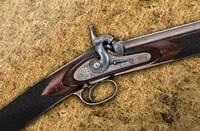
| Good Pattern 1844 Yeomanry Cavalry Carbine This is a very good P-1844 Yeomanry Cavalry Carbine.
The P-1844 Yeomanry Carbine was adopted as a somewhat smaller and lighter variation of the P-1843 Second Pattern Victoria Carbine. Both guns utilized a P-1842 percussion lock, designed by George Lovell who was appointed the Small Arms Inspector at the Royal Small Arms Factory at Enfield Lock (RSAF) in 1840. Lovell was a very forward thinking and modern armorer, and strove for uniformity in production, high levels of quality control and sought to produce the most modern and perfected percussion weapons in the world. Lovell’s influence on British military small arms from the late 1830’s through his tenure as Small Arms Inspector had a major influence on British military small arms design and production.
The M-1844 Yeomanry Carbine had a 20” smooth bore barrel that was nominally .66 caliber, a reduction from the Victoria Carbine’s .73 caliber bore. The smaller caliber was more in line with the traditional English carbine bore of .65 caliber. The barrel was secured to the stock by a screw through the tang of the breech and a pair of barrel wedges, of the same design that Lovell had introduced for the P-1842 musket, which replaced the pin barrel designs that the British military had utilized since the late 1600’s. The gun had a simple fixed post rear sight; a captive swivel ramrod and a single brass rammer pipe to help keep the ramrod secured when not in use. The butt plate and trigger guard were also of brass. The trigger guard had a skeletonised pistol grip extension to its rear, similar to that of the Brunswick rifle trigger guard, and the forward bow sported a single sling swivel. A sling bar of about 7” in length was mounted to the left side of the carbine
This carbine is in very good to fine condition with a crisp lock, plethora of proof and view marks and has the letter RMLYC engraved on the butt plate which I am told explains it was issued to the Royal Midlothian Yeomanry Cavalry. Metalwork is excellent and the woodwork is sound, altogether a very pleasing example and becoming scarcer. One comment I would make is that there are six uniform scratch or "tally" marks near the foresight which clearly were put there deliberately. Were these to indicate battle success. I doubt if you would take the trouble to do this shooting rabbits!
Feel free to ask any questions or for additional images to serious enquirers. |
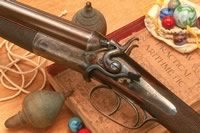
| 11 bore hammer gun by T J Watkins Now here is an interesting shotgun! It is an 11 bore under lever shotgun manufactured by Birmingham Gunmaker T J Watkins circa 1868. If ever you wanted a magnificent looking breech loading hammer shotgun to hang over the fireplace without worries about security issues then this is the one for you as it is in a scarce obsolete calibre! The shotgun has an excellent grained walnut butt and fore end with an unusual chequered partially engraved iron butt plate, iron being the sign of quality at the time and indicative of "that bit extra". Good chequered wrist and fore end with just one sliver missing from the left hand sde of the fore end but not really noticeable. The butt has a nice silver (possibly gold if not tarnished silver) inlaid escutcheon. Foliate engraved side locks , trigger guard and tang and decent damascus barrels with a mellowing patina with some slight pitting if you look for it. The makers name is engraved on the top rib and side plates with a brass foresight. Mechanically sound with good striking firing pins and a decent bore and an action that locks tight.
This gun was originally made as a 10 bore and obsolete 10 bore cartridges fit perfectly but it was proofed as an 11 bore by the Birmingham proof house based on barrel size and marked accordingly. If you measure the barrels they are 11 bore which also fits the proof limits for 10 bore.
Overall a very decent gun and probably worthy of restoration which could prove economically viable and would greatly enhance its value but here it is priced to sell.
There is an interesting anecdotal piece of provenance that accompanies the gun which was purchased many years ago in an antique shop in Monmouthshire and that is that vendor stated that the gun was made for the Sheriff of Worcester who at that time would have been a William Hanford Flood see the London Gazette Entry at www.london-gazette.co.uk/issues/23704/pages/474
A lot of gun for your money! |
| 15th Century Mortar This is an exceptionally early English Mortar dating from around 1450 and would have been in use probably until the end of the 16th Century. The mortar is unusual insofar as it has been hand forged and not cast and overall is 8" high with a 1.5" diameter bore within a 3.5" octagonal barrel. The mortar is marked with an incised cross and has a large touch hole and priming pan.
The mortar has a 15 Degree cant which indicates that some aggressive use was anticipated but it is believed that these were generally used for signalling and for advising time during encampment on campaign.
The piece is heavy and weighs more than 20 pounds, It is remarkable that this has survived and English ordnance of this age is scarce if not rare. |
| 17th Century Executioners Axe 17th Century Executioners Axe circa 1650 , modern handle for representation only, original handle would have been significantly longer. Gruesome unpleasant artefact but rare and seldom available. Cutting edge approximately 8", Length of blade 14.5".
Hand forged.
|
| 1863 Petengill Revolver This is another first for Pembroke Fine Arms the rare Petengill revolver. If you are a black powder shooter it may be ringing some bells with you and you would be right! This was the predecessor of the well known Rogers and Spencer Revolver, look at the barrel and the grips.
A total of 1,500 Pettengill Army revolvers were delivered in 1862 with another 501 being delivered in early 1863 making a total of 2,001 received by the government during the six months before mid January of 1863. However, existing serial numbers, ranging from 1600 to 4600, would indicate that about 3,000 were actually produced. The serial number on the government inspected arm featured in this posting is 4307. Many of these arms were issued to the Army of the Mississippi under General William S. Rosencrans and other Federal troops in the West. They very likely were used at the Battle of Perryville, Kentucky in 1862 and although a failure in the field and officially "discarded", many undoubtedly served through the war or at least until the user thereof could replace it with a more efficient side arm. It's front end design was later incorporated into the Rodgers & Spencer .44 cal. single action revolver, which, although the better of the two arms, arrived too late for service in the war.
This rare example has no original finish but the grips are fine and it works. There is some surface pitting but it is so rare as an example that it would probably merit a refinish and that's something I have never, ever commented on before so it must be rare!
Something for the advanced collector who has everything but not one of these! |
| 4 pound cannon later carriage Now I don't intend to lugg this around the arms fairs and it has come in as a part exchange. Lets list the defects first!
Later white oak carriage not original.
Touch hole half spiked in the correct manner so it needs to be taken out.
Bronze weld on the breach ring which was revealed when the black paint was removed.
Other than that I think that it would look great if it was repainted or treated with Zeebrite fireplace blacking. I am not a cannon chap as I would hate to take it to the range but I am told it is a 4 pounder, Length is 43.5" , bore is 3.5" and it has the tapped holes for a flintlock ignition system and sights.
Probably manufactured in Falkirk Scotland by the Carron Ironworks.
There are no markings that I can see and the weight is in the region of 2.5 cwt. I can arrange a reasonable delivery cost dependent on where you are.
Because of the sheer logistics of moving the item this is sold on a non return basis only. |
| 54 Bore double barrel percussion pistol This is a good quality Potts double barrel 54 bore pocket pistol with drop down twin triggers. Clearly from the state of the woodwork and the crisp mechanics the pistol saw little use. On cocking the pistol each trigger drops down and locks and then on firing springs back into its recess immediately and with some force. The barrel appears to be hammer forged with an elaborate demascus type motif which is difficult to discern from my photographs but should not be mistaken for pitting. This type of pistol was a "heavy weight" of its time and was manufactured around the time of the emerging transitional revolvers.
The overall barrel lengths are 4.5" exposed, 5" internal and the overall length of the pistol is 9.5". 3" barrels are more commonly seen on these pistols.
Overall a quality example of a British made and proofed double barrel pistol and difficult to improve on. |
| Adams 54 Bore tailed bullet mould. This fine mould stamped Adams Patent was manufactured circa 1851 and designed for the Adams revolver which was initially produced without a rammer, the principal being that the cast tail of the bullet was pushed into a wad to retain the bullet in the cylinder.This did not always work! Bullets would sometimes fall out of the cylinder sometimes to the fatal embarrassment of the user and as a consequence of this the system was dropped and replaced with a rammer system to seat slightly oversized bullets tightly. Probably less moulds extant than revolvers! A fine mould. |
| Adams Revolvers - A W F Taylerson Essential reading for the collector of English revolvers. This is the only specialist book published on Adams' revolvers and now long out of print. A very good copy.Book Description: Barrie & Jenkins, London, 1976. Hardcover. Book Condition: Very Good. Dust Jacket Condition: Very Good, plastic cover. First Edition. 240 pages, well illustrated, cloth, very good. From the Wikipedia website: "Robert Adams (1809-1880) was a 19th-century British gunsmith who patented the first successful double-action revolver in 1851. His revolvers were used during the Crimean War, the Indian Mutiny, the U. S. Civil War, and the Anglo-Zulu War. ~ In 1867, Robert Adams' brother John Adams patented a breech-loading revolver which was adopted by the British government in place of the Beaumont-Adams. It was a solid frame pistol with six chambers, in .450 caliber. After official acceptance of his pistol, Adams left the London Armoury Company and established his own factor, the Adams Patent Small Arms Company. His pistol was manufactured in three distinct variations (differences related mainly to methods of spent cartridge ejection) between 1867 and about 1880. The models were tested and adopted by the British Army and Navy, with the last, the M1872 Mark III, seeing the widest use. The John Adams revolver remained the official sidearm of the British Army until replaced by the Enfield Mark I in 1880."
Price includes postage. |
| Adams/Tranter 54 Bore mould. This is an Adams or Tranter unmarked conical 54 bullet mould with 2 cavities and a later sprue cutter. Ideal for making up a cased set or as an accessory to a 54 bore revolver. This one is in reasonable condition as can be seen from the photographs. |
| Allen & Wheelock 31 calibre Although the firm of Allen & Wheelock was only in business for eight years - from 1857 to 1864 - it produced a surprisingly large variety of firearms. This is one of them! Their products included single shot, double barrel, 4, 5, and 6 shot pepperbox pistols; single barrel, double barrel and revolving cylinder rifles, both muzzle loading and breech loading; and over 20 revolver models with more than a hundred variations. Included in this proliferation were the five percussion revolver models with which we are concerned. This entire arms production was based upon the various patents of Ethan Allen.
Allen held 22 firearms patents, of which five were applicable to percussion revolvers. The first, No. 3,998 of April 16, 1845, was .not granted for a percussion revolver but for a pepperbox. Its double action mechanism, in which the hammer was raised and dropped and the barrels revolved by a single pull of the trigger, was an improvement on his 1837 patent, which applied only to single shot pistols. The revolving mechanism was very simple a screw in the side of the trigger pivoted an arm, which acted on the ratchet on the rear of the cylinder. Many percussion revolver makers used variations of this.
This particular pistol is in 31 calibre and is cased in a modern box containing the pistol, a contemporary percussion cap tin and an aluminium mould to produce balls to suit the pistol.
The action on this is fine but no finish remains which is reflected in the price. A good honest little pistol that represents a transitional stage which culminated in the revolver as we know it today. |
| American Small Arms - Edward S Farrow Edward S Farrow was probably the best person qualified to write this book in 1904 as a result of his extensive military experience.
For example he discusses one encounter "During (my) association with the Unatilla Indians and when (I) captured the tribe of "Sheepeater" Indians in the Salmon River Mountains of Idaho in 1879 (I) had a great variety of arms at my disposal for the purpose of making comparisons. No two Indians possessed arms of the same pattern and caliber and yet with few exceptions each thought his arms possessed features of merit"... Rare book, 1st edition 408 p.p +2 Profusely illustrated with excellent engravings, illustrations and photographs featuring the well known and not so well known arms of the era. |
| Bergmann Model 1896 No 3 Automatic Pistol The Bergmann Automatic Pistol is instantly recognisable and R K Wilson in his tome "Textbook of Automatic Pistols" considered the Bergmann to be the first true automatic pocket pistol. Theodore Bergann began experimenting with self loading pistols at an early date, his first patent was published in 1892! This is a well made arm of simple blowv back type. It is significant that there is no mechanical extractor, when the bolt opens there is still sufficient gas available to blow the cartridge case out backwards. The case then strikes the next round in the magazine and in theory bounces clear. A gas escape port in the chamber acts as a safety should the case rupture. The early cartridges had no rim of any kind and relied on a sharp taper to avoid any risk of jamming in the chamber.
Wilson also regarded this as the most accurate and "pointable" pistol on the market an felt it was better suited to close combat than the Mauser C96 which he states in a derisory manner is a "continental officers pistol, looks good on the hip and designed for long range shooting when the enemy aren't close!"
This particular pistol is in fine condition as can be seen and is accompanied by it's magazine which is more of a stripper clip than a magazine and much rarer than the pistol itself as most were lost.
This is an excellent example of a Bergmann Pistol for the advanced collector and in an obsolete calibre so in the UK you don't have to be a criminal to own it!
|
| Bill Reid VC autographed print - an extraordinary man! Bill Reid was Scottish and an extraordinarily brave but modest man. His Lancaster Bomber was badly strafed during a bombing raid and his navigator and other crew members killed but he carried on with his mission, dropped his bombs and returned home despite being severely wounded and as a consequence saving the remainder of his crew. On a later mission his aircraft was hit and severed in two by a bomb dropped from above him and he kept the aircraft in the air long enough for his crew to bale out and just managed to bale out himself landing heavily and breaking his arm.
This limited edition print entitled "Chadwick's Masterpiece" is only one of 10 that were signed by Bill Reid three years before he passed away. The print is glazed and measures 21" x 15" and is an excellent representation of a Lancaster Bomber as flown by one of the bravest pilots of the War. See Bill Reid's VC citation as below ;
He was awarded the VC on 14 December 1943. The citation reads:
Air Ministry, 14th December, 1943.
The KING has been graciously pleased to confer the VICTORIA CROSS on the undermentioned officer in recognition of most conspicuous bravery: —
Acting Flight Lieutenant William REID (124438), Royal Air Force Volunteer Reserve, No. 61 Squadron.
On the night of November 3rd, 1943, Flight Lieutenant Reid was pilot and captain of a Lancaster aircraft detailed to attack Dusseldorf.
Shortly after crossing the Dutch coast, the pilot's windscreen was shattered by fire from a Messerschmitt 110. Owing to a failure in the heating circuit, the rear gunner's hands were too cold for him to open fire immediately or to operate his microphone and so give warning of danger; but after a brief delay he managed to return the Messerschmitt's fire and it was driven off.
During the fight with the Messerschmitt, Flight Lieutenant Reid was wounded in the head, shoulders and hands. The elevator trimming tabs of the aircraft were damaged and it became difficult to control. The rear turret, too, was badly damaged and the communications system and compasses were put out of action. Flight Lieutenant Reid ascertained that his crew were unscathed and, saying nothing about his own injuries, he continued his mission.
Soon afterwards, the Lancaster was attacked by a Focke Wulf 190. This time, the enemy's fire raked the bomber from stem to stern. The rear gunner replied with his only serviceable gun but the state of his turret made accurate aiming impossible. The navigator was killed and the wireless operator fatally injured. The mid-upper turret was hit and the oxygen system put out of action. Flight Lieutenant Reid was again wounded and the flight engineer, though hit in the forearm, supplied him with oxygen from a portable supply.
Flight Lieutenant Reid refused to be turned from his objective and Dusseldorf was reached some 50 minutes later. He had memorised his course to the target and had continued in such a normal manner that the bomb-aimer, who was cut off by the failure of the communications system, knew nothing of his captain's injuries or of the casualties to his comrades. Photographs show that, when the bombs were released, the aircraft was right over the centre of the target.
Steering by the pole star and the moon, Flight Lieutenant Reid then set course for home. He was growing weak from loss of blood. The emergency oxygen supply had given out. With the windscreen shattered, the cold was intense. He lapsed into semiconsciousness. The flight engineer, with some help from the bomb-aimer, kept the Lancaster in the air despite heavy anti-aircraft fire over the Dutch coast.
The North Sea crossing was accomplished. An airfield was sighted. The captain revived, resumed control and made ready to land. Ground mist partially obscured the runway lights. The captain was also much bothered by blood from his head wound getting into his eyes. But he made a safe landing although one leg of the damaged undercarriage collapsed when the load came on.
Wounded in two attacks, without oxygen, suffering severely from cold, his navigator dead, his wireless operator fatally wounded, his aircraft crippled and defenceless, Flight Lieutenant Reid showed superb courage and leadership in penetrating a further 200 miles into enemy territory to attack one of the most strongly defended targets in Germany, every additional mile increasing the hazards of the long and perilous journey home. His tenacity and devotion to duty were beyond praise |
| Brander & Potts Flintlock Pistol This is a good untouched Brander & Potts Flintlock pistol in 18 bore. The pistol has a nicely swamped 9" brass barrel featuring the makers Minories London address and has not been messed with in any way - a nice find and good representative sample of a flintlock pistol circa 1805. Martin Brander and Thomas Potts are recorded at 70 Minories and Goodman’s Yard between 1802 and 1827
Some wood loss on left hand side of forend as can be seen from photographs hence the price but really only "honest travel" and age worn. |
| Brass Flintlock Pistol by John Twigg John Fox Twigg, Gunmaker, London (1732-1792)
This approx 24 bore (.57) flintlock pistol circa 1770 exudes quality and is an excellent example of this outstanding and celebrated gunmaker's art and would enhance any fine collection of English Flintlocks. Wood has a beautiful mellow patina and the overall lines of the pistol are clean and without significant blemish as can be seen from the photographs.The pistol is in good working condition and features Twigg's early signature and it should be noted that contemporary "copies" of this celebrated gunmaker are known but this is Twigg "through and through"
John Fox Twigg was born at Grantham, Linconshire, in 1732 and is listed by Heer (1978) as being apprenticed to the Irish gunmaker, Edward Newton (active 1718-1764), though no dates for the apprenticeship are offered.
By 1755, Blackmore (1986) lists Twigg working as a gunmaker from Angel Ct., Charing Cross until 1760 when he moved to 132 Strand, opposite Catherine St., and continued at this address until 1776.
He moved again in 1776, this time to Piccadilly where he remained until 1790. During these 14 years he opened several warehouses; at little Somerset St., in 1771; 30 Cornhill, 1777 and Tower Hill in 1779. His only son, John, was apprenticed in 1786 to Henry Nock, and subsequently inherited his father's business.
In 1788 Twigg formed a partnership with his newphew, John Bass (b.1761 - d.1794) although this was cut short by Twigg's death. As Blackmore notes, however, the trade directories are misleading in this respect, and show the business continuing at Piccadilly until 1795. |
| Brevet Nagant Rook and Rabbit Rifle in 45 calibre This is an attractive little rifle of the "rook and rabbit" genre manufactured in Belgium under the Nagant patent. The quality of the rifle is excellent with crisp mechanics and a good bore. The rifle is chambered for Colt 45 and was probably intended for the US market.
An unusual little rifle in an unusual calibre for its type.
I can hold without charge for a variation to acquire and can ship to a RFD of your choice. See this at the Birmingham International Arms Fair February 17th. |
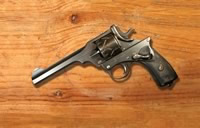
| British Bull Dog Revolver Here is an example of the gun that "really won the West".
The Bull dog revolver was cheap, portable and mechanically sound and a fraction of the price of a Colt or Remington. Although introduced by Webley thousands were made in Belgium, France and Germany and even copied in the USA. This particular example is in excellent condition and retains most of the original nickel finish with good grips. This one is in 320 revolver and exhibits Belgium proof marks. The Liege proof was a much stricter test than British proof so these revolvers were built well. |
| Brunswick later pattern rifle by Holland Here is another Brunswick rifle manufactured by John Holland and Sons. This is a British made rifle not to be confused with the rifles manufactured in Nepal. In total there were only 30,000 Brunswick's manufactured and as they were quickly replaced by other rifles, survival rates of British rifles are modest and a rifle by Holland even scarcer.
Professor Christopher Road, in his excellent book "The British Soldiers Firearm", explains how Holland & Sons were a London based firm and one of the four main contractors in 1852 to produce this pattern but withdrew from their contract because they couldn't make a profit no doubt because of the amount and quality of work that had to go into each rifle and their workmen advancing their cost by 16.25%. Unusually the lock post dates this contract by 9 years but in 1861 Holland accepted a contract to supply Lancaster rifles to the Army and no doubt this was an occasion where old stock was recycled and a batch of Brunswick's supplied and dated to that year.
John Harris Holland later merged with his nephew Henry Holland to establish the renowned firm Holland & Holland.
This particular rifle is marked with Holland's stamp on both the barrel and the lockplate ( John Holland Barnett ). Metal is in the white and the wood has a pleasing patina. The cleaning rod is original as is the patch box lid, trigger guard and cleaning rod ferrules. It should be noted that most of the Nepalese imports have modern reproduction patch box lids and triggers as these were taken off to be sold as scrap in the past.
There is no doubt that this rifle saw service it has the usual dents and scrapes that you would expect on an issued 150 year old rifle but there are no major problems. Bore is dark but there is plenty of deep rifling as you would expect on a Brunswick. This rifle was manufactured for issue to Colonial forces as evidenced by the "I" under arrow stamped on the lock. Altogether an attractive looking rifle and manufactured by one of the better makers. |
| BSA 303 Sporting Rifle This BSA rifle was manufactured by BSA from the best of their military surplus stock and regulated to shoot the .303 Mk V11 "high velocity" round. There were two grades of these rifles manufactured and this was the better grade. This rifle has an excellent bore. good chequered stock with Express sights and detachable magazine. These rifles were carried in Africa and were used to shoot everything from Elephants to Antelope.
The rifle has the advantage of being light, superbly balanced and quick to point. In their day they were regarded as fine rifles and their cost reflected that, now they are sadly underestimated and disappearing quickly. Sold with the relevant BSA catalogue page from the 1932 catalogue. .303 calibre, Section 1. |
| Californian Gold Rush Bowie Knife
This Bowie knife has an overall length of 12" and a blade length of 7.5".
Knife has excellent etching which reads " Californians ask for nothing but for what is right and submit to nothing that is wrong"
Also " I can dig Gold from Quarts" and "The Californian Bowie Knife". The knife is stamped with the makers name and VR with a crown circa 1845 -1855.
Ivory handle with later sheath, a rare blade and highly sought after. |
| Calisher & Terry 30 Bore Volunteer Rifle This is a superb and scarce rifle. The Calisher and Terry patented breech loading rifle was used with great success by British and Colonial forces worldwide. Approximately 16,000 were manufactured between 1857 and 1869. The Confederate General "JEB" Stuart was renowned for carrying a C&T as his personal side arm. Most C&T's are encountered as Carbine's and it is rare indeed to find a rifle with a full length stock. This Volunteer rifle has an excellent walnut stock, good bore, iron mounts and the lock is engraved Calisher and Terry 1869. The rifle has a 30 bore 5 groove 32" barrel with a bayonet lug and rear ladder sights which has turned to a pleasing blue brown patina.
The C&T was a capping breech loader and the forerunner to modern bolt action British rifles. A manufactured combustible cartridge was placed in the breech and ignited by a percussion cap which offered the user faster loading and the opportunity to fire and load prone - a huge advantage compared to conventional muzzle loading rifles of the time. The breech was sealed with a greased leather washer .
An impressive rifle! |
| Cartridge Display Board Ideal for your gun room this is an amateur produced shotgun cartridge display board to illustrate many types of shotgun cartridge ranging from tiny shotshells to large signal cartridges. Many are collectible in their own individual rights such as early pinfire and large bore brass cases. This is an interesting display that is 1/10 of the cost of a professional board such as Kynoch but nevertheless is pleasing to look at.
Featured under shotgun category because I cannot guarantee that some of the cartridges are inert so I must see a shotgun certificate to hand over. Any apparent visual defects to the glass are due to my poor photographic skills and are not evident "in the flesh".
As far as delivery is concerned this is heavy and glazed and whilst I can pack it well it is not the best item to ship but I do travel extensively and could deliver along the M4, M5,M6
This is the sort of thing we would all like to make but haven't got the time to do!
Thank you for your interest. |
| Case pair of Muff Pistols This is a pair of hidden trigger box lock percussion muff pistols retailed by Wetherhead & Waller.
The later case is in French style and contains a bullet mould, powder flask, cap tin and turnscrew.
The pistols are in absolutely perfect order and cock and lock crisply with very little wear. These have seen very little use. |
| Cased Colt London Navy Revolver This is a decent Colt London Navy with the top strap address reading - Address- Col.Colt, London. Serial No is 27696 all matching including the wedge and the correct London dome headed screws. 36 calibre 6 shot with a 7.5" octagonal barrel. Overall condition is very good with a high percentage of the original varnish still on the walnut grips and a very visible cylinder scent. This gun has not been messed with and the dome head screws are perfect except some "Bubba" has chewed up the cylinder wedge screw as can often be seen as this is the only screw that should be touched. The revolver is cased in a contemporary Colt case with the original Colt patented double cavity mould and a contemporary Dixon type powder flask. There is also a nipple key, Eley cap tin and some old bullets with some Kapok wool for cleaning. This came out of an old american collection and has an old type written label. Overall this is a very pleasing set and at a price less than I have seen similar quality revolvers selling for.
Colt London's are under estimated as there were only 42,000 manufactured compared to 215,438 manufactured in Hartford USA and it is said that Colt used some of his best artisans and skilled men in London as he felt at the time that the British market with its Empire was his best opportunity. |
| Cased Colt London Pocket Revolver Good cased London revolver with no real flaws. All original and honest with crisp mechanics,good bore, no nicks or dents on barrel and no one has tried to use it as a hammer! The screws haven't been messed with and this is a real "sleeper" and as good as you will find for the money.
This set has all of the original accessories including the Colt marked mould, nipple key cleaning rod and correct Dixon's powder flask.Original loading instruction sheet although faded and much original varnish left on grips. A much better gun than many offered and in its original case with key and functioning lock. All serial numbers match including the wedge and there is much silver plate on the trigger guard and a good cylinder scene including "Colts patent" and evidence of safety stops on the cylinder. I have seen worse sets than this retailing at considerably more money. This is a very nice example of a Colt London pocket pistol. Colt was reputed to have sent many of his his best craftsmen to London as he felt that Britain and its Empire was the largest potential market for his wares and as a consequence the London guns attract a premium over USA manufactured models.Feel free to ask questions. |
| Cased Colt London Pocket Revolver This is a good fifth model Colt Pocket London with matching serial numbers including the wedge. The top strap is stamped "Address Colonel Colt London" The cylinder has an excellent cylinder scene and there is evidence of case hardening extant as can be seen from the photographs. The revolver has the usual London refinements of domed screws and heavier cross hatched hammer spur.
The case is 100% Colt as is the mould which casts a conical and ball bullet. The flask is contemporary but not the usual Dixon, and the loading instructions are original. The bore of the revolver has fine and deep rifling but there is some minor pitting but overall this is a fine example and better than most.
The serial number dates the revolve to 1855.
This is fresh to the market and has been in one family's hands for 150 years. The family explained that the original owner bought it from new to protect his licensed premises in the East End of London!
This is overall a very decent cased set that hasn't been messed with and at a reasonable price for the quality. |
| Cased Foudroyant medal This mint condition medal was made from Copper salvaged from the copper bottom of Nelson's flagship Foudroyant. This was minted in the Centeniary Year after Trafalgar and is complete with its original case. Very scarce in this condition. |
| Cased J Purdey Hammergun This is an interesting gun formerly one of a pair made to special order for Audley Harvey in June 1885. Captain (John) Audley Harvey was an officer in the 42nd Scottish regiment although his family were from Devon.
After Harvey the gun has been in the ownership of the Baskerville family who kindly confirmed provenance.
This gun is in a contemporary leather travelling case with a number of accessories including the original double tampion, cleaning rod and Purdey snap caps.
The gun has some very nice features, and these include exceptional quality engraving of a game scene, the spaniel almost looks as if he will jump off the lock plate. The top rib has the usual Purdey address with the addition of noting that they are made from Sir Joseph Whitworths fluid steel. There are the normal proofs with the addition of a "not for ball" stamp next to the viewing and proof marks. Originally the gun was supplied with a gold escutcheon on the butt but sadly this was removed some time in the past, previous owner states it came into their family after the Great War and was missing the escutcheon then, possibly because it had the original owners initials but more likely because of the depression and the fact it was gold.
Gun is tight and obviously in proof and the owner state it was recently re-jointed for shooting after a "retirement" of 40 years! There is some pitting in the internal mid section of the barrels but not enough to stop use but at the price and quality these would merit sleeving for regular hard use. Barrels are 30" long and length of pull is 14.5". An ideal game or pidgeon gun with a lot of history and character and worthy of investing a little time and money to bring up to specification, not exactly a sleeper but certainly a "rouser" !
This will need a shotgun certificate to transfer.
SEE US AT THE BRISTOL ANTIQUE FINE ARMS FAIR SEPT 2nd |
| Cased LAC Kerr Revolver This is a good representative cased Kerr side hammer 54 bore revolver. The side hammer is very similar to a shotgun side lock and the rationale was that the revolver could be easily cleaned, serviced and repaired by anyone with a modicum of skill.
James Kerr had been the foreman for the Deane, Adams and Deane gun factory. Robert Adams, one of the partners and inventor of the Adams revolver, was Kerr's cousin. Kerr developed an improvement to the Adams revolver, British Patent No. 1722 of July 28, 1855, and when Adams left the Deane brothers to found the London Armoury Company on February 9, 1856, Kerr went with him. The London Armoury Company manufactured military rifles and revolvers. Kerr designed rifles for the company based on the 1853 pattern Enfield rifled musket. When the company directors decided to focus on rifle production in 1859 Adams left, taking his revolver patents with him.
Kerr designed a new revolver in .36 caliber and .44 caliber (54 bore in British measurement). Production began in April 1859. The British government did not initially purchase the weapon and civilian sales were modest.
However, the U.S. Civil War began in 1860 and the governments of both the United States and the Confederacy began purchasing arms in Britain. In November 1861, 1,600 revolvers were purchased for the Union army, at $18.00 apiece. However Confederate arms buyers Maj. Caleb Huse and Cpt. James D. Bulloch contracted for all the rifles and revolvers the Armoury could produce (and the Confederate government could pay for.) As a result, the London Armoury Company become a major arms supplier to the Confederacy, selling the most of the 11,000 Kerr revolvers produced to Huse. The Kerr revolvers sold to the Confederacy were said by William Edwards in his book Civil War Guns to be those between serial number 3,000 and 10,000, but earlier serial numbers are thought by collectors to have also been shipped to the South, and there are no good records to show the exact number sold to the Confederate buyers.
Many of these revolvers are spuriously marked with an Anchor to signify Confederate usage and if the provenance is proven they command a high premium. This particular revolver was "liberated" from our American cousins but I can make no claims about Civil War usage except it was acquired in the USA. The revolver has reasonable grips as can be seen and has the original correct Kerr double belted bullet mould which is foliate engraved and scarce.
Correct powder flask and contemporary accessories but the case has been latterly relined but quite a good job has been made of it.
An important English side arm that should be part of any British revolver collection. |
| Cased Tranter 54 Bore Revolver This is an excellent second model double trigger Tranter revolver in 54 bore accompanied by a set of usual accessories to include a bullet mould, correct Dixons powder flask, cleaning rod, bullets and lubricant etc. In the oil bottle compartment is a curious accessory that hasn't been identified. It has the external appearance of an oil bottle but has been machined to accept a 54 bore bullet and has a steel spike on the inside with 4 laterally cross drilled holes. One hypothesis is that it was used to make "Dum-Dum" bullets. The revolver is crisp and mechanically sound with a good bore and superb lock up. There is no real wear , scratches or dents and has more original finish on one side than the other. This would be graded in the top 20% of such revolvers and is a very pleasing set. |
| Charles Lancaster Target Pistol Here is something you will not see every day! A rare Charles Lancaster Saloon or target pistol in obsolete 320/230 Rook Rifle. Is this a cut down rifle? Probably not as some research has resulted in another surfacing. An image of a similar pistol has been posted by the celebrated author Joel Black on the Gunboards Forum and he confirms that this is in the same calibre and definitely a pistol and not a cut down rifle.
Charles Lancaster was famous for his four barrel Howdah pistols which had a patented rotary firing pin action, he also made a variety of other weapons including rook rifles. We can surmise that this was made to compliment a rook rifle and in the same calibre and was probably made up as part of a commissioned garniture.
In more relaxed and times and long before 1984, target shooting at home on the lawn or even indoors was a popular hobby and many makers produced "saloon" or target pistols, usually in .22" calibre which have been prohibited by our politicians as being too dangerous to own. This however, is not prohibited and as close as we can get to owning one of the early target pistols that can now only be seen in museums.
See Stewart's excellent book on William Tranter to see more illustrations of similar pistols. |
| Civil War Dog Lock Blunderbuss / Musketoon circa 1645 This is the oldest English gun I have ever had the pleasure of handling This is an English Civil War Dog Lock Blunderbuss or Musketoon with a 25" barrel and an overall length of 39.5". Diameter of the bore is approximately 1" flaring to 1.5/8", approximately 4 bore. This dates from around 1640 and has a second English lock with early London Gunmaker's view mark identified as circa 1640 from Howard Blackmore's excellent book British Military Firearms 1650-1850. Originally this would have had a thick wrist but this has been reshaped about a hundred years later, maybe as early as 1720 and is now similar to the more familiar "Brown Bess". The forend has also been repaired in the distant past and the horn tipped ramrod has been added later (probably 18th Century). The gun has been used and remodelled to suit both fashion and practicality for at least a hundred years since it was first made. I've personally never seen such an early English gun in private ownership, most are held in museums.
See Baxter ( Arms and Armour Press 1970) for more information. Feel free to ask for more photographs if interested and I will consider part exchange and lay away on this item |
| Colt .38 Rimfire New Model Breech Loading Pocket Pistol Colt .38 Rimfire New Model Breech Loading Pocket Pistol
This is an excellent nickel-plated example of the Type 5 Pocket Pistol as described in the definative work on these guns, "Variations of Colt's New Model Police & Pocket Breech Loading Pistols" by Breslin, Pirie and Price. It is one of a run of 3,425 newly made pistols that first shipped in 1875. The serial number range of this type is from 1750 to 5450 in the second serial number range; the serial number of this revolver being 4605.
The condition of this revolver is better than the example illustrated in the book cited above. It retains 90% plus of original nickel plate to the cylinder, barrel and frame with a complete and sharp stagecoach scene on the cylinder. The hammer retains all its original finish and the brass trigger guard has mellowed to a mustard colour with some original plating in protected areas. The action is tight with perfect timing and solid lock up. It appears to have had very little use as indicated by the strong rifling and the chambers of the cylinder still retaining their internal plating. The grips are in good condition with about 90% plus original varnish, the screws are undamaged and those attaching the trigger guard and grip, still have bright charcoal blueing. The patent marks, barrel address and serial numbers are all clear and sharp. It would be difficult to find a better example of this early Colt breech loader and it would make a fine addition to a serious Colt collection.
Barrel length 3.5"
Overall length 8.5"
Should you wish to acquire a Colt Dragoon, this would be relatively easy to achieve. Should you wish to acquire an example of this model in this condition, this would be very difficult.
|
| Colt 1862 Police Revolver Considered by many gun collectors to be the pinnacle of the Colt's factory streamlined revolver design, this five-shot cap and ball weapon has matching serial numbers of 12021 including the cylinder, wedge and spline. Production in the third or fourth quarter of 1862. The five-shot, rebated and fluted cylinder has mellowed to a plumb colour. Cylinder nipples are not chipped nor broken, and the safety pins are not completely hammered down. Hammer lip extremity has some small chips often seen on this revolver but not too bad as can be seen. Cylinder is matched with a 5½" long barrel and a creeper-style loading lever. A clear and sharp "ADDRESS COL SAML COLT NEW YORK US AMERICA" marks the top of the barrel. All barrel gunmetal has mellowed down with some minor evidence of bluing and frame exhibits traces of the original casehardening. Piece shows a pleasing mix of plum with a bright and dusky gray patina overall. The bore is very nice with crisp rifling and no evident pitting, clearly this gun has been looked after.
The standard "COLTS / PATENT" is stamped on the left side of the frame. Revolver is mechanically crisp with strong action and excellent lock up. Grips are of one-piece, varnished walnut, strong and tight and exhibit slight shrinkage. Triggerguard shows faint traces of the original silver-plated wash remaining. The small stamping ".36 CAL" is visible on the brass triggerguard. Frame screws are very good and not messed with.
These revolvers were originally designed for Security agents such as Police and Pinkerton's agents and had a small foresight for rapid drawing and quick close pointing and firing. These are scarce as only 28,000 were manufactured over a 10 year period and many were converted to metallic cartridges so pleasing examples are not easy to find in the UK. This particular revolver issued in 1862 may well have ended up in the hands of a Civil War soldier as many did.
Altogether a pleasing Colt. |
| Colt London Navy Revolver This is a decent.36 calibre London Navy manufactured in 1855 in Col Sam Colt's London factory and impressed on the top of the barrel in deep and legible letter's with the London address. This Colt has all matching numbers including the wedge and has an overall mellow patina. There is some original varnish left on the grips and although some pitting in the barrel it was not "shot out" and has good rifling in the bore. Mechanically it works well and there is a solid lock up. This revolver has had some "honest travel" and has not been messed with. One slight problem is loading lever latch which has some fault but does operate. This revolver is a family heirloom and is purported to have been privately purchased by a British Army Officer and of course the date is right for the Crimea but it has no ordnance marks. There is no engraving evident on the cylinder and is so smooth one wonders if there ever was?
The Colt London is iconic insofar as Colt believed at the time that the British trade would be his most important so he ensured that he employed the most skilled of workmen and ensured the materials and finish were top rate. For a superb background to Colt's London revolvers read Rosa's book Colonel Colt London. |
| Colt Navy 1861 Model I've looked at literally hundreds of Colt's and it would appear that
the Colt Navy 1861 is pretty rare compared to the 1851 Navy. In broad terms the 1851 outnumbers the 1861 by 10 to 1 and the survival rate of 1861's is reckoned at less than 3% so there are probably only around 1000 extant.
This revolver is an extremely good looking example as there are no major "dinks" or scratches and the grips are excellent.
The bore on this revolver is excellent and the revolver indexes , cocks and locks tightly. This revolver would be suitable for adding to a FAC subject to inspection by a qualified gunsmith and proofing.
This particular revolver has the safety stops left which is a big plus when considering Colt's. The safety stops are little pins that protrude from the cylinder which you rest the hammer on between the caps when you are carrying it. These wear first
and are the first things to look for when considering condition as they are virtually impossible to replace so if they are flat , even if the gun looks decent it has had considerable use. The grips are good with no cracks or wood missing and a high level of original varnish left and no one has used this as a hammer which is very common and the first thing to look for when excessive wear is possible. Screw heads are not buggered and the overall finish is a low pleasing "plum" patina.
Loading lever works fine and the Colt Legend is readable on the top of the barrel as is the patent no on the cylinder and there is some cylinder scene. Serial numbers match on everything except the wedge but this is no real problem because it has a serial number contemporary to the revolver which means it is not a modern reproduction. These things were lost and people replace them and this wedge has come from another Navy of that era. As can be seen from the photograph there is a clear inspectors mark on the trigger guard.
Overall a very nice looking Colt and a scarce model in good mechanical order and competitively priced. |
| Colt Single Action Army 1875 45 Colt British Proofed 1899 This is an extremely attractive looking SAA in 45 Colt which exhibits London Victorian Proof marks including Nitro proof marks on a gun that was originally made for black powder rounds. The serial number dates the manufacture to 1899.
The action is perfect and the bore is mirror clean and the hammer has "all the clicks", overall a handsome gun. The American purist would frown on the British proof marks but I feel these add character and rarity, not from a financial sense but from the sense that this awkward but easily pointed gun clearly took someone's fancy in the UK whilst having to compete with the Webley Government one of the finest revolvers ever made.
To look at contemporary development of this revolver whose serial number is in the 182000 range,in 1896, at serial number 164,100, a spring-loaded base pin latch replaced the cylinder pin retaining screw and by 1900, at serial number 192,000, the Colt Single Action was certified for use with smokeless powder.
From 1873 through 1940 (with small numbers assembled during and after World War II, the so called "Pre-War, Post-War" model), production of the Colt Single Action Army reached 357,859. This is identified as the "Pre War" or "First Generation" of the model. Calibers, at least thirty in all, ranged from .22 rimfire through .476 Eley, with approximately half, or 158,884 (including Bisley and Flat Top Target variations), chambered for .45 Colt. The next most prevalent were the .44-40 Winchester Center fire (WCF) at 71,392; 38-40 (38 WCF) at 50,520; 32-20 Winchester (32 WCF) at 43,284 and, the 41 Colt at 19,676.
This gun has a tiny chip out of one corner of a grip.
Sadly in the UK this is a Section 7 but I am happy to store at no charge for certificate variation and can usually arrange to hand deliver. |
| Commonwealth Outriders Blunderbuss circa 1660. This is a rare and untouched item that has not been available on the market for many decades having been held privately since before the Second World War. Ex-Hampton Court, ex- Lord Hereford and Baskerville collections, this gun is quite extraordinary and a formidable weapon in its time.
The lock is English but of Huguenot manufacture and clearly the gunsmith was showing off his art at the time! The 2 ring three stage cast iron barrel is 16" long with an overall length of 29" long. Make no mistake, iron denotes quality, this was a more difficult material to work with than brass and could accept larger charges. One of the wonderful things about this blunderbuss is that the woodwork was painted at the time to simulate the best burr walnut which would have easily deceived at a distance, a device sometimes used in 17th Century furniture. No doubt the weapon was bought by someone who wished to enhance their station or by someone of stature that wanted to make a good impression! The fact that it has not been worn or sanded off in 350 years is incredible! A similar example can be seen in Baxter's work on Blunderbusses. ( Arms and Armour Press 1970).
There is some evidence of worm hole that has been treated decades ago and is non active but the rest is untouched and unmolested. This is one of the very few but finest examples of an early long arm outside of a public collection. Additional images available and would consider part exchange on this item. |
| Continental percussion target pistol circa 1855 This is an attractive foliate engraved Continental 18 bore target pistol of quality. Barrel length is 7" and has pronounced rifling and the pistol is enhanced with a percussion cap compartment in the butt.
Overall a very attractive pistol. |
| Daw & Company Cased Percussion Revolver
Daw Percussion revolver with very good bore and mechanics , lots of original finish and in a correct Daw case with nice contemporary trade label but clearly the case has been messed around with to fit this gun but can be sympathetically and easily repaired.
The quality of Daw's patent revolvers was always exceptional and this is no different, they were recommended by a number of people in the shooting world including Lord Elcho and Llewellyn Jewitt and also by General Garibaldi.
SEE THIS AND OTHER INTERESTING GUNS (AND US) AT THE BRISTOL FINE ARMS FAIR SEPT 2nd. |
| Deeds that thrill the Empire. 5 volume set of this iconic work that is essential reading for the Great War medal collector. True accounts of heroism in the field leading to awards of gallantry medals. Very good reading copies but covers rubbed as can be seen and some loose content but nothing missing or drastic. |
| Dutch Beaumont Rifle Model 71/88 This is a good Dutch Beaumont 71-88 rifle that was used by the Dutch Army at home and in the Dutch East Indies. This rifle is all matching and with the cleaning rod which is often lost and has an amazing number of stamps and cartouches. There is a fine Maastricht cartouche on the butt dated 1878 and various other proof marks and ciphers. Condition is good, mechanically excellent, nice bore , good walnut stock with no chunks missing except a thin crack on one side only of the butt as can be seen. This rifle started life in 1878 and then was converted with a Vitali magazine, the bolt is complex and contains the spring for the firing pin a feature copied by the Japanese for their Murata rifle ( Don't they copy everything!). Sadly the Beaumont had a short life as it couldn't compete with small bore smokeless powder propelled ammunition such as the Mauser so was replaced soon after the Vitali modification. This is a big chunk of a rifle for your money and is a real "sleeper" this has the patina of laying idle for over 100 years and hasn't been cleaned. Originally these were supplied in "the white" and this could be cleaned up nicely. |
| Early Adams 54 Bore This is a very early Adams patented self cocking or "automatic" revolver in 54 bore. The serial number is under 1000 and pre-dates the investment into Adams by a merchant bank. This is a significant revolver as it does not have a rammer but used spiked bullets pressed into a wad. This proved unsatisfactory as bullets could drop out of the cylinder much to the embarrassment (or demise) of the owner. Subsequently rammers were fitted as standard or often as a retrofit to earlier models. This revolver has not been touched.
The Adams revolver was a very significant development in British Firearms History and nice examples are scarce. Ultimately it was the quality of Adams' work and his contemporaries such as Tranter and Webley that lead to the demise of Colonel Colt's manufacturing aspirations in the United Kingdom.
The revolver has good mechanics and cocks, rotates and looks without problem and is tight. There is over 50% of the original finish remaining and even some case hardening evident. As can be seen the grips are very good and indicative of the quality of the revolver, there is a percussion cap compartment in the butt.
The full Adams & Deane address is engraved and nicely visible along the top strap and there is strong rifling in the bore.
Other than transitional revolvers this would have been about the first serious competition to Colt who was emerging with great success at this time.
A very pleasing revolver. |
| English Civil War Harquebusier's I am privileged occasionally to handle artefacts of historical significance that may send a shiver down my spine. This is one of those artefacts!
This is an English Civil War period iron Harquebusier's Helmet commonly known as a “Lobster Tail” helmet because of the truncated neck guard which looks like a lobster’s tail. These helmets were worn by both sides but predominantly by Royalist’s. The term “roundhead” has nothing to do with this or any other helmet this term was used in a derogatory sense because Cromwell’s troops kept their head shaved and wore very simple uniforms. The analogy is that of being called “square” in our youth in contemporary times.
This type of helmet was stocked in the Tower and private arsenals prior to the war as well as produced for the war, thus dating it about 1635-45. Iron skull made in two pieces with a rolled central seam. The pivoting peak or brim with rolled edge and suspending a triple bar face guard. A number of examples of this type were preserved at Littlecote House, and are now at the Royal Armouries, formerly Tower of London. This example has definitely seen combat with a contemporary riveted repair to the peak band at the right side and a distinct sword blow impact mark to the right side as well which probably caused the damage needing repair. These helmets were worn over knitted felt “Monmouth” caps and it is likely that the wearer was concussed but survived that particular blow. The cheek pads have been removed which was not unusual at the time and a virtually identical example without cheek pieces can be seen in the National Trust collection. The point of the peak is slightly distorted from lamination or straightening an impact damage. The neck guard and peak shows slight loss to the rolled edge as can be seen in the photographs and not unusual in an artefact that is at least 373 years old. I have steel buckets in my garden two years old that have not lasted as well!
Most Lobster tails were imported but this is an English example and overall very pleasing with a wonderful patina that has developed over nearly 400 years and has clearly been cared for by generations of custodians to arrive with me. This is an item that looks better in the hand than any photograph can do justice to. This is not a stage prop (many so called “original” lobster tails are actually Victorian, made for theatrical use) but a genuine artefact that was most definitely used in earnest as can be seen from its “battle scars”. There were surprisingly few battles in the English Civil War and in my day you were taught them, Marston Moor, Adwalton Moor, Naseby, Roundaway Down and Newbury. There were also several sieges notably at Gloucester, Oxford, Hull, Newark and Carlisle. This is a Lobster tail helmet that would have been worn by an individual present at one or more of these events, no doubt about it and that is what sent the shiver down my spine!
|
| Excellent H Nock Double Barrelled Travelling Pistol This is a mahogany cased double barrelled travelling pistol by Henry Nock which started life as a flintlock pistol but was expertly and expensively converted to percussion firing by Witton and Daw and is presented in its Witton and Daw case with original trade label and complimented by its accessories. The quality of this piece is excellent with wonderful 7” brown Damascus steel barrels, original case hardening and perfect lock mechanisms.
The bore of the pistol measures at .57” so approximately 24 bore and the case contains the correct ball mould to suit but also a small leather pouch of swan shot so clearly the original owner meant business and this would have been an intimidating piece to face! Other accessories include a powder flask, additional cleaning rod, oil bottle, turn screw and original box of percussion caps
Both locks function perfectly and are marked H Nock while the top rib bears the engraving "H NOCK LONDON MAKER to his MAJESTY". Bores are perfect. The grip has an un-engraved silver escutcheon and the case a similarly un-engraved brass plaque. The case also contains an 1803 Halfpenny coin which could indicate the manufacturing date and I am told has been with the case since living memory. This is a top of the range pistol by a pre-eminent maker and worthy of any collection as it offers an interesting piece in exceptional condition by a superior maker that exhibits the transition between flintlock and percussion with an expert conversion that cannot be criticised on quality.
Nock was a prolific inventor and is best known for his formidable multi-barrelled volley guns which were purchased by the Royal Navy and in recent years brought back to public notice by the TV series Sharpe in which Sergeant Harper carries a Nock Volley Gun. There is an interesting and erudite article on Nock and his volley guns in the Gun Report magazine of October 1967 and I would be pleased to make a copy for the purchaser of this pistol if interested. Nocks volley gun also formed part of the arsenal of HMS Pandora when she sailed in pursuit of the mutineers of HMS Bounty in 1791.
Howard Blackmore stated that Nock never made an inferior military or civilian gun and his contribution to the advance of gun making in general has sadly been considerably overlooked,
MacDonald Hastings in his book, English Sporting Guns, pages 8 and 9, supports the enthusiasm of
Blackmore , stating:
“HENRY NOCK of London, with his patent (No. 1598) of April 25, 1787, achieved a breakthrough. Prior to his patent, the plug was a solid lump of metal. When the flint sparked the powder in the pan, the flame spurting into the touch hole ignited only a corner of the charge . . . In NOCK’s gun, . . . the priming powder fired in the middle of the charge. Guns shot harder and quicker . . . it was from NOCK’s patent that gun invention leapt forward.”
Another common word we use today in respect of firearms is the “Knox form” which is a derivative from “Nocks Form” another of Henry Nock’s patented inventions.
Here is a very limited biography of this pre-eminent gun maker.
Henry Nock, Gun maker, London (1741-1804)
Henry Nock opened business in London in 1772, appearing in the rate books for 1772 as a gunlock smith at Mount Pleasant, London.
In April 1775 he formed a partnership with fellow gun makers, William Jover and John Green, to sell firearms made under English Patent No.1095 from 83 Long Acre. By 1779 he had moved to the Whitechapel district and appears at Castle Alley in Whitechapel the following year, 1780. That same year he designed and produced 7-barrelled guns for the Board of Ordnance and followed it up with a screw less lock (1786), a wall piece (1788), the Duke of Richmond's musket (1792), Royal House Artillery pistol (1793) and a cavalry carbine and pistol in 1796.
From 1784 until his death in 1804 he was based at 10 Ludgate Street, with factories at Moses and Aaron Alley, 27 Goulston Street and 9 Castle Alley, Whitechapel. Across the same period he had a shooting ground at Clowters Gardens behind St. George's Church, on Blackfriar's Road. During these years he took out his own patent, English Patent No. 1598 in 1787 for an improved breech design.
Shortly after moving into the Whitechapel district, Nock made a set of gauges for the Gunmakers Company Proof House in 1781, but shortly afterwards severed his ties with the Company by purchasing his freedom in 1784. This move reflected the sentiments of many gun makers who worked outside the Company's control over London's inner city area. Blackmore (1986) describes the situation: 'To the west extending along Fleet Street to the Strand and Charing Cross, and north to Long Acre and Holborn, were new generations of master gun makers who had served their time elsewhere and had no traditions of service with the City Companies.'
From 1771 until 1804 Nock was a contractor to the Board of Ordnance and from 1777 until a year before his death, he was a contractor to the East India Company for the supply of arms.
In July 1778 the Gunmakers' Company, after having argued that the loss of income was in part due to the lack of a Livery, petitioned the Lord Mayor and the Aldermen and were successful. As a result, the Gunmakers Company took its place in the social life of the City and played its part in its business and politics, including the election of Aldermen and the Lord Mayor. Obviously attracted by the newly found status in being attached to the Company, Nock took Livery in 1795 and rose through the ranks to become Assistant in 1792 to finally Master in 1802.
He died in 1804 and was succeeded by his foreman and son-in-law, James Wilkinson (d.1849). James Wilkinson is the Wilkinson behind the famous Wilkinson Sword company who also retailed guns.
(original sale not completed as a result of purchasers circumstances)
|
| Excellent Remington 1871 Rolling Block Pistol Here is another 1871 Remington Rolling Block Pistol in obsolete 50 calibre Remington centrefire.
It is hard to know exactly why Remington made rolling block pistols when they did, since revolvers were so well established. Probably they were already tooled up for rolling block rifles, so making pistols didn’t require an additional investment. Remington revolver sales were in a slump, because from 1855 to 1871 Smith & Wesson had effectively tied up manufacture of advanced cartridge revolvers by licensing the Rollin White patent that covered any cylinder drilled through from end to end. Remington had only percussion pistols on offer during those years.
The 1871 pistol was modified from earlier versions by moving the trigger and trigger guard forward and adding a spur to the grip to assist in controlling recoil. A firing pin retractor was also added. This pistol was commonly called the "Army and Navy".
Manufactured circa 1872 to 1888 with a total production of approximately 6,000, with approximately 5,000 sold to the U.S. government. The pistol has an 8" blue barrel, casehardened frame with the distinctive 'hump' or spur on the back strap, the trigger is niter blue and bright hammer and breech block. The left side of the frame is marked "REMINGTON'S ILION N.Y. U.S.A. / PAT MAY 3D NOV 15TH 1864 APRIL 17TH 1866" and stamped with a "P" and "S" below and ahead of the marking. The pistol is mounted with a smooth walnut forearm and one piece smooth grip with a boxed script "C.R.S." inspection cartouche on the left.
There are no major blemish's , a bright bore, crisp mechanics and some evidence of case hardening left with a nice blue trigger. Overall mottled patina as can be seen with a plum barrel. Not quite museum quality but at the top end of these very scarce pistols. Evidently little used if at all and the screw heads indicate it has not been messed with.
These pistols are underestimated and are an interesting diversion from the revolvers that were dominant at this time.
|
| Excellent Webley Model 1909 9mm Browning Long Of all of the Webley pistols available for collection, other than the Mars the Model 1909 must certainly be the most elusive of the type.
The Webley 1909 was short lived and was only manufactured between 1908 and 1922 and only 1694 examples were ever made. This particular pistol was manufactured in December 1914. The pistol was intended for military or police use with a smaller calibre than the service issue .455 calibre but lacked the power needed for its service. The pistol has several important innovative refinements including a grip safety which was replaced on later models with a slide safety, a slide stop which kept the slide open after the last shot was fired and a positive magazine release. Many of these features can be seen on the Colt 1911 government.
This particular example is in extremely good shape and would rate as NRA fine with more than 85% finish and no internal wear with a superb bore. The hard rubber grips only show slight handling marks. Most of the original vibrant blue is extant and the balance is mellowing to a plum patina. This calibre is accepted as both Section 7(1) and Section 7(3).
Price on application because of method of transportation. |
| Extraordinary Civil War Sharpshooters Spectacles This is quite an extraordinary item insofar as it demonstrates a degree of technical competence way ahead of its time and is a fragile artefact that has survived.
These glasses make a remarkable difference to your sight picture in all degrees of light and were used by sharpshooters to improve their performance. These spectacles were reputed to be found in the Fredericksburg area of Virginia and handed down for generations. Fredericksburg was an area in which some of the most savage battles of the American Civil War were fought with casualties running into the tens of thousands.
This is a very personal and poignant item that would have been used by a "sharpshooter" or sniper who would already have some renown and be issued with a special rifle. I doubt if I will ever see the like again. |
| From Smooth bore to small bore Essential reading for the muzzle loader! Dr Roads' book is probably the best available resource to research the British Military Muzzle loading rifle and it's variants. Book Details -
Herbert Jenkins, London, 1964. Publisher's Cloth. Book Condition: Near Fine. Dust Jacket Condition: Very Good+. 1st. Octavo. FIRST EDITION. "From Smooth-bore to Small-bore". 332 pages. 360 plates. In original navy-blue cloth boards, gilt-lettered to spine. Illustrated dust-jacket in very good condition not price-clipped. Clean and tight throughout, no inscriptions other than previous owners blind stamp.
|
| George Daw Revolver This is a very pleasing and early and possibly a prototype Daw's revolver in a sympathetically relined case with original powder flask, some tools and reproduction oil bottle. The Daw was a well received revolver and much publicised by exponents such as Hans Busk. Daw was a self publicist as Colonel Colt was and he took every opportunity to promote his arms and presented one of his patented revolvers to General Garibaldi. The Daws has a "hesitating lock" and the principal is that, unlike the contemporary Adams self cocking revolvers, the Daws shooter could hesitate the hammer as it was pulled back allowing a steady aim. This revolver is unusual insofar as it has been fitted with brass nipple shields which has not been seen before. The proof marks are British and there is evidence of a small plug on the top strap which may have something to do with its suspected prototype origins. This is a high quality and interesting revolver with much original finish, good locking mechanism and crisp grips. |
| Good Cased London Hartford Navy Revolver .36 calibre Here is a very good cased London Navy 36 calibre revolver that will appeal to the advanced Colt collector as it has so much going for it.
The quality of Colt's London firearms was exceptional because he viewed Britain and his territories as his most important market ( The USA was only emerging as a significant power at this time ) and sent many of his finest workmen to London to set up the production line. Colt's London factory failed for a variety of reasons including competition from better evolved English revolvers and some partisan opposition to his wares. Colt London made revolvers are easy to identify other than the obvious "Colt London" address and the identifying marks include a cross hatched hammer and domed screw heads which were not incorporated into the USA manufactured arms. On the closure of Colt's London factory all part finished revolvers were shipped back to the USA and finished and many were sent back to be sold at Colt's London Sales Office. (Colt was tenacious and never quite gave up in the UK)
These models are known as Colt London Hartford model and this is one of those.
The revolver features all of the London characteristics such as domed screws and address but the "give away" detail of a Hartford finished revolver is the bevelled bullet cut out which made loading the bullet a little easier and the late serial number. This particular revolver has all matching serial numbers including the wedge which was often lost and replaced and has some other features of significance which include the rather rarer dove tailed foresight and an iron trigger guard. The revolver is mechanically sound,cocks and locks and has prominent rifling in the bore and there is around 60% of the original varnish on the grips left and the barrel has clean lines without any nasty nicks which are common. There is a very good cylinder scene and all of the proof marks are clear and the screw heads are good. There is some scattered impact marks on part of the cylinder but other than that it is a fine revolver.
The case has all of the correct accessories, a Dixon flask, patent mould, nipple key, cleaning rod and Japanese lacquered percussion cap box.
Of considerable interest is a bell shaped Hawksley oil bottle with an earlier serial number. This exact oil bottle which is marked Colt can be seen in Rosa's excellent book "Colonel Colt London" with the comment "later added". This is a bit of a vague remark and could mean later added when the revolver was finished in Hartford but the fascinating thing is that this cased set which is a different set has the same bottle which would tend to indicate that these bottles were used for cased London revolvers although the commonly seen bottle is the Dixon's round bottle.
In the recent Heritage Arms (May) auction, the same oil bottle can be seen in a factory cased presentation Colt Navy so although scarce these are contemporary to the set.
The case has the original loading label (not a repro)
and a functioning lock with key. Some of the internal partitions could do with some attention but everything is there including some oxidised bullet heads.
This revolver was purchased in Ohio, USA so I do not think it returned to Britain and is in an "as found" condition that could be improved should you be so inclined but I would leave this up to you.
Colt firearms are increasing in value exponentially as there is a huge Colt collecting fraternity and there won't be any more. This is a good honest example and a lot of history and variation for your money but not quite ( but not far off ) good enough to command some of the 5 figure prices you see at the major Auction houses.
I would be pleased to send more photographs to seriously interested parties. |
| Good Colt London Pocket Pistol in 31 Calibre Of all of the Colt's available to British Collectors, the Colt "London" has to be the most iconic. Manufactured and proofed in Britain it is accepted that the quality of workmanship is better than the USA made revolvers and this can be evidenced in some of the attention to detail such as dome headed screws and much greater defined cross hatching on the hammer spur. Colonel Colt believed that Britain and it's Empire was potentially his most lucrative market and spared no expense or effort in attacking it. To appeal to the market he had these arms stamped "London" and gave free samples to anyone and everyone of importance from Royalty down. For an excellent account read Colonel Colt, London: The History of Colt's London Firearms, 1851-57 by John Rosa.
As to this example, we can see that it is a very handsome pocket revolver in .31 calibre with a 4" barrel that has not been messed with and is in NRA very good condition which means that the bore is good and there is 30% of original finish including varnish on the grips and there are no serious marks and the lettering is sharp and exactly as it should be. All of this can be seen from the photographs and I can send more if required but to be specific which a grading cannot explain; the revolver has mellowed to a pleasing dark patina and has clearly not been cleaned with abrasives at any time. The domed screw heads have seen some use but are not "buggered" ( Official USA phraseology for describing screws! ) and the cylinder scene is extant, not 100% but clear. Mechanically there is no problem and as previously mentioned the bore is good with nice deep rifled grooves. This is an early example and the serial number is 5051. The revolver is profusely marked with British proof and view marks on the frame, barrel and cylinder.
All in all an honest gun and difficult to beat at this price. To transcend from this very good example to NRA excellent grade you would have to pay four times this price but would you achieve four times the enjoyment? I doubt it. |
| Good Le Faucheux Revolver This is an extremely good Le Faucheux pinfire revolver in 9 mm pinfire calibre (Obsolete) this is one of the finest pinfire revolvers I've handled and as usual there is superb bluing on the cylinder and the barrel which the photographs do not do justice to. This revolver has seen little if any use and will cock, lock and index as the day it was made. The loading gate spring is very tight, another indication of little use and the revolver has excellent grips. Unusually this revolver has a trigger guard, most are seen with drop down triggers. Liege proofs indicate manufacture between 1860 and 1870 and of course the Liege proof exceeded British proofs- they did not make much rubbish. Le Faucheux revolvers were high quality and were exported in quantity to the USA during the Civil War. If you wanted a representative example of a pin fire revolver, you couldn't do better than this one. |
| Good Live Firing Mauser K98 dated 1941 Mauser K98 in 7.92/8mm Mauser Calibre, maker's mark of Bcd dated 1941. This particular example is in top order with an excellent bore and decent sling. These Mausers were battlefield "pick-ups" by the Russians at Stalingrad and Leningrad and were arsenal refurbished and released for sale after the Cold War. Unusually this one still has a swastika extant as these were centre stuck out by the Russians who obviously missed some. A good example of an iconic rifle now becoming scarcer.
Purchase of this item will require a Firearms Certificate. |
| Good Portugeuse Mauser Kropatschek Rifle
The Mauser-Kropatschek is perhaps one of the finest, most well-made rifles of its generation with an incredibly smooth action throughout, and this example is no exception. Manipulating the bolt is as smooth as silk and trigger pull and let off of the trigger is crisp and clean. The rifle is complete, with original cleaning rod. Some of these rifles were later designated for colonial service and fitted with a top hand guard, which is usually missing. This is one of those rifles that almost certainly saw colonial service in Portugal’s colonies. The metal is smooth and in very nice condition with 50% blue remaining on the barrel and receiver and with bolt parts finished in the white. The stock has good cartouches showing on both sides but of course there are some minor handling marks throughout. No cracks. No stock repairs. Nice bore. Like almost all Portuguese Kropatscheks, especially the colonial, the bolt group serial numbers don’t match the barreled receiver and stock, which do match each other. The bore is excellent and this rifle is eminently shootable as well as an important variation for the 19th century collector.One small problem, easily fixed is that the rear leaf sight spring needs replacing. Originally chambered for a black powder cartridge, it was updated to a smokeless cartridge by the alteration of the rear sight, extending its range. Rifle is complete with all original parts and all markings visible. |
| Great War Medal Trio Drvr C M du Preez SASA This trio is accompanied by an original photograph of Drvr du Preez and the Victory Medal is bilingual.
I was told by a customer that when he was doing National Service in South Africa he became friends with a du Preez family who owned a gold mine! Worthy of further research.
Medals are G.VF. |
| Greene (British Type) Carbine 1855-57 This is a 54 bore capping breech loader of exceptional quality. James Durell Greene was a prolific firearms inventor and determined to make his mark! This carbine was manufactured by the Massachusetts Arms Company and exported to Great Britain after being inspected and stamped with the Queens Crown by British inspectors in the USA. These were used by the British Cavalry in the Crimean War but re-exported to the USA after the Crimea War. These were deemed to be very accurate but the paper and linen cartridges of the time were criticised as being prone to swell in the damp and consequently the carbine did not find favour with the British Government. The carbine features an unusual "floating thimble" to obdurate the breech and an internal "pricker" (see photograph) that punctured the cartridge. It also featured Maynard Tape priming which was in the forefront of priming technology at the time and the mechanism for this is in perfect condition. The patch box contains some old instructions for loading and firing the carbine and the carbine will be supplied with some interesting articles published on the weapon some 40 years ago. The quality of workmanship is exceptional and it breaks and locks as crisply today as it did when it was made 156 years ago.
An exceptional item in outstanding condition. Only 2000 manufactured and most broken up as evidenced by numerous examples of lock plates extant in the market. |
| Greener W.W.Greener was a prolific and reputable manufacturer of rifles and his range covered everything from Big Game rifles in large calibres to gallery target rifles in .22 RF. This is an exceptionally interesting little rifle - a MkII Sharpshooter's Club rifle in obsolete 310 calibre in a take down version. The take down facility is fast and positive, simply push forward the barrel latch and unthread the barrel. The idea here was to allow the rifle to be carried in luggage ( those were the days! ).
This particular rifle has a minty bore and plenty of original finish on the Receiver. Mechanics are fine and should you wish to place this on a FAC, it would make a good shooter.
These rifles are becoming difficult to find as so many were erroneously handed in during firearms "armistices" and more than difficult to find in such pleasing condition. If you consider that the average cadet rifle is now selling at £650 this is a sound investment.
See this at the Bristol Antique Arms Fair Sunday 3rd March. |
| Greener Best Express Rifle W W Greener is famous for many patents and his shotgun's found International repute. Greener offered every conceivable type of firearm including revolvers, whale harpoon guns and flare guns. An area that the Greener company specialised in was single shot rifles, many of which were sold to the Colonies for hunting Big Game. This is a superb example of a Greener single shot rifle in .375 Express calibre which is a flanged round and not to be confused with the .375 H&H introduced by Holland and Holland in 1912. This rifle is of excellent quality with an unusual "jewelled" engraving on both sides of the receiver. The bore is excellent and the wood is also very good and the rifle has perfect mechanics and has seen little use.
These are uncommon rifles as many were replaced with bolt action rifles and not preserved. |
| Greener Humane Cattle Killer Now this is UNUSUAL! A Victorian Greener cattle killer circa 1895 complete with box. A fantastic thing for a Greener Collector or the collector of the unusual.
This gun metal pistol/killer fired a 310 bullet (Obsolete) into the brain and spinal cord for a quick death. The large gunmetal or bronze cup protected the user from both sound and ricochets.
This is complete with two INERT 310 rounds as seen in the photo. The only negative is the original leather handle has been replaced with a plastic one but this could be replaced. Very rare in its original box.
The top unscrewed and the cartridge was placed inside and the striker was hit with the wooden mallet. This one is virtually unused. |
| Hopkins & Allen XL revolver. Hopkins & Allen Arms Company was a US firearms manufacturing company based in Norwich, Connecticut that was founded in 1868 by Charles W. Allen, Charles A. Converse, Horace Briggs, Samuel S. Hopkins and Charles W. Hopkins. The Hopkins brothers ran the day-to-day operations of the company.
In 1874 Converse sold his interest in the company to brothers William and Milan Hulbert, giving the Hulbert's 50% of the company's assets and capital. Hopkins & Allen became the exclusive maker of Merwin Hulbert revolvers as a result of this. Following the bankruptcy of the Hulbert brothers in 1896, Hopkins & Allen went bankrupt in 1898. The company was reorganized as Hopkins & Allen Arms Company but lost its factory and machinery in a fire in 1900, also along with the great robbery in 1905 shortly after, thieves cleared out the whole warehouse.
This particular revolver is more substantial than most "suicide specials" as they were called as it is in 38 calibre. This revolver has a solid frame and good mechanics and interesting grips featuring a "hound dawg" motif. The top strap is stamped "Hopkins & Allen Mfg Co" Pat March 1871 and May 1878" and XL No 5 38 RF.
Another interesting revolver.
|
| Huge Webley Pryse Style Counet .500 revolver
Other than some surface roughness and minor pitting here and there, this revolver is in surprisingly good condition after at least 120 years of existence. And this was one of the biggest shooting machines available especially for British Officers as well as for any others who wanted a true man-stopping firearm (see paragraph below). The action works quite well both SA and DA and the lock-up is fairly tight with some minor movement in the cylinder. The bore is in very good condition with strong rifling and some minor pits here and there. The extraction system operates just as it should. The original nickel is only found in a few spots and small areas, otherwise the lines and marks are good. There is more minor surface pitting on the barrel and barrel assembly (as well as some larger areas on the cylinder), and unfortunately one of the spots of noticeable surface pitting is right where the original marks are stamped at the left rear of the barrel. But the marks are still visible enough to work out the following: BREVET COUNET, 3463 - this number is most likely a patent number because the serial number is stamped further down on the action itself: 4482. The caliber of 500 is also stamped on the left of the barrel assembly. This revolver is a classic Counet with the large headed bolt on the left, which when turned with the arrow pointing back allows the center post to be removed. The revolver uses the Pryse system for the opening of the top-break mechanism. This is the full Pryse system with the two fingers that lock bolts into both sides of the post on the rear of the barrel assembly – while adding a bit of complication to the top-break system the Pryse locking mechanism was a much safer system than the type of lock used on the Smith & Wesson (and its copiers). The revolver also has the finger rest under the trigger guard, which in the handling of the larger revolvers really does help in steadying the gun for firing; it doesn’t help on any quick draw attempts, but a gun this big wasn’t designed either for fancy draws nor for spinning in the hand. The grips are in good condition showing normal wear, and the entire original pattern is still present. For size comparison I have shown the revolver next to a Webley .450 Calibre Bulldog, itself a "chunky" revolver, the Counet .500 is substantially larger, and that with only 5 chambers! The barrel measures 5-5/8 inches (142mm), and overall the revolver is 10-5/16 inches long (262mm). The revolver is marked on the rear of the cylinder with the inspector’s mark of a star over R (1877 to 1968) and the pre-1894 Liege proof. This proof was the very best in Europe in the 19th century; each chamber had to be proofed or proved by firing a double load 4 times. No junk ever got past that proof. Several manufacturers in Great Britain, France and Germany sent their finished small arms to Belgium just for this proof. Altogether this is a fine Counet/Pryse system revolver manufactured in Belgium to some of the strictest requirements in 19th century Europe.
THE COUNET-PRYSE PATENT: Phippe Counet patented this particular revolver in Liege in 1876 and it was available in chamberings from .320 right up to .500 Webley, as with this one. We actually found one about 5 years back that was chambered for the monster .577 cartridge. Philippe Counet was registered for proof tests in Liege between the years of 1865 and 1905. Having the 1877 inspection mark as well as the pre-1894 Liege proof means that this revolver was manufactured sometime in this period. But I assume it was made closer to 1880 when the .500 Webley round came out.
A MARKET AMONG BRITISH OFFICERS: Although the big-bore Belgian and British revolvers were sold commercially to anyone who wished to haul a cannon around, the main market to which these were directed was the officer corps among the British armed services. The Zulu troubles in South Africa and uprisings in Sudan had taught the British Military that they needed handguns that were chambered for something more powerful that the .450 Adams cartridge that had been the first centerfire, brass cased cartridge to be used by the British. The British eventually chambered their ordinance revolvers in the new .455 (sometimes called the .476) in 1892. But in answer to the call of the officer’s themselves, who had to purchase their own sidearms, the .500 Webley or .500 Tranter cartridge had already appeared sometime about 1880 (see paragraph below). The .500 Webley revolver became almost the sidearm of choice for hundreds of British officers who wanted a big enough punch to actually stop in their tracks any attacking enemy (and in most cases kill them with one shot). The only commerical cartridge that surpassed the .500 was truly big .577 Webley. That was a round that was not topped in overall impact (and pure destruction), even with its relatively slow velocity, until the .41 Magnum appeared in 1964. The only setback to packing a .577 Revolver around was the huge machine that had to be built around the bullets. It was the kind of revolver that was more often kept under the seat on a wagon or stage than in a holster, because all that weight in a holster either caused a horribly lopsided stride or worse, brought about the embarrassing phenomenom of encounting ones trousers around the ankles. Even the big .500 requires a strong hand and steady aim, and was never the favorite revolver of the quick draw crowd. The battle experience of British Officers using this big round was enough to keep interest high and keep manufacturing of these revolvers and their ammo profitable right up into the first decades of the 20th century.
THE .500 WEBLEY CARTRIDGE: The .500 Webley or .500 Tranter revolver cartridge, was introduced around 1880 in England for use in revolvers based on the Tranter and Webley patents. It was designed in answer to the call of British officers for a truly man-stopping handgun cartridge. The bullets weighed in the range of 340 to 350 grains and developed about 650 fps with its black powder load (that doesn’t sound like a screaming bullet, but nothing was left standing when it hit). British production of the cartridge ended by 1920; |
| Husqvarna 600 Rolling Block Elk Rifle in original case. Magnificent is not a superlative I use very often but in this case I will make an exception.
This is a cased Husqvarna Moose or Elk rolling block rifle in approximately 600 calibre. The rifle is in superb condition and has seen very little use, there is vibrant case hardening still extant on the receiver and the chequering is crisp and sharp. Swedish Rolling block hunting rifles are often encountered as the Swedes were one of the first nations to adopt Remington’s innovative design for their military and naturally civilians also wished to use what was considered the most advanced rifle of its day. In later years many military rifles were sporterised to give further service but these are generally seen in the 12mm calibre range, this beast is more than double the size of these and has been designed for one thing alone, stopping power to hunt the largest mammals extant in the Northern Hemisphere.
The bore of this rifle is excellent and measures 0.618” and should you wish to place the rifle on a firearms certificate to seek the extremely elusive British Moose, cases can be fire formed from 24 gauge brass shotgun cases and the rifle is accompanied by a custom made mould. The Swedes produced these rifles with virtually straight rifling which allowed the user to shoot both ball and shot to circumnavigate shooting laws at the time which prohibited the shooting of Elk with shotguns so the gun had a dual purpose as it could be used to fire shot as well. The size of the projectile fired by this rifle is quite extraordinary, a standard 0.577” Enfield Minie bullet simply drops through the barrel!
The action on the rifle is crisp and there are no significant defects to report and this would make the centrepiece of any rolling block rifle collection and would be difficult if not impossible to improve upon.
See this and other interesting rifles on my stand at the Birmingham International Arms Fair Sunday 17th February. |
| Large travelling This is a very nice 26 bore double barrelled percussion travelling pistol by B. Bonnet. Very high quality of manufacture, name under the wood and with a German proof. Top strap is not engraved and judging by the quality this was a trade piece that would have been sold to be stencilled by the retailer. Cocks, locks and has a crisp action and overall a good looking example and large enough almost to fall into the Howdah pistol category!. |
| London Armoury Company P-1853 Pattern Rifle The London Armoury Company Pattern 1853 probably were the best of the Military P53's and renowned as excellent shooters with the advantage that the parts were readily interchangeable with other P53 rifles as a consequence of quality of manufacture and uniformity.
This LAC dated 1863 has solid bands, indented lock and a nice bore , just the thing to put onto a FAC if you wish and bring it back to life. This rifle hasn't been messed with and has the correct ramrod, woodwork is excellent with the exception of somes mall pressure dents on the right hand side of the butt which would steam out if you were fussed but it's not my job to interfere with history! ( see photo )
The rifle has mellowed to an even patina and has all the correct marks you would expect.Original LAC cartouche is still extant which is indicative that the wood has not been sanded or messed with. Sharp screw heads and bands and it looks as if the rifle has never been taken apart. Good shooting bore with strong rifling some shadowing at the end of the barrel but not bad at all.
Overall a good example of a rifle pattern that was used in the Crimea and during the US Civil War. An above average example! |
| London Small Arms Co Martini Henry BSAC provenance Now this is an exciting rifle! If you are looking for a standard Martini Henry these are easy to come by and thousands have entered the market from the IMA Nepalese cache where they were stored for over 100 years and had never been pointed or fired in anger. Great examples admittedly but no real history other than the fact that they are Martini’s made in the day.
This however is a little different as it has plenty of history and definitely would have been used in Africa for the purpose it was intended for. If you are looking for history this is it, if you are looking for a rifle with an excellent bore to put onto a FAC this is also it.
Why is this rifle so special? Simple, it is an MkII/1 manufactured by LSA Co (London Small Arms Co) which was only made in limited quantities and LSA is reputed to be one of the better makers, and it ended up being issued to the British South Africa Co who definitely saw action and were the backbone of the infamous or famous Jameson Raid.
The British South Africa Company (BSAC) was a mercantile company incorporated on 29 October 1889 by a royal charter given by Lord Salisbury, the British prime minister, to Cecil Rhodes. The company was modelled on the East India Company and was expected to annex and then administer territory in south-central Africa, to act as a police force, and develop settlements for European settlers. The charter was initially granted for 25 years, and was extended for another 10 in 1915.It was intended that the BSAC would develop the region without significant cost to the British tax payer. It was therefore given the right to create its own political administration supported by a paramilitary force for protection of settlers against local peoples.
Profits from the company, in terms of diamond and gold interests were reinvested in the company to allow it to expand its area of influence. African labour was exploited partially through the application of hut taxes, which required Africans to look for wages.
Mashonaland was invaded by a Pioneer Column in 1830, then the Ndebele in Matabeleland. This formed the proto-colony of Southern Rhodesia (now Zimbabwe). They were stopped from spreading further to the North West by King Leopold’s holdings in Katanga. Instead they appropriated lands which formed Northern Rhodesia (now Zambia). (There were failed attempts to also incorporate Botswana and Mozambique.) The BSAC was involved in the Jameson Raid of December 1895, and they faced a rebellion by the Ndebele in 1896 which required the aid of British to quell. A further rising of Ngoni people in Northern Rhodesia was suppressed in 1897-98.
The Jameson Raid
The bulk of the participants in the Jameson Raid were BSAC troops armed with Martini Rifles and two Maxim machine guns secretly supplied by the British Government. The basic plan was that “Uitlanders” (British immigrants) in Johannesburg would revolt and seize the Boer armoury in Pretoria. Jameson and his force would dash across the border to Johannesburg to "restore order" and with control of Johannesburg would control the gold fields.
However Jameson waited and waited for the insurrection to move but in the meantime differences arose within the Reform Committee and between Johannesburg Uitlander reformers regarding the form of government to be adopted after the coup. At a point, certain reformers contacted Jameson to inform him of the difficulties and advised him to stand down. Jameson, with 600 restless men and other pressures, became frustrated by the delays, and, believing that he could spur the reluctant Johannesburg reformers to act, decided to go ahead. He sent a telegram on 29 December 1895 to Rhodes warning him of his intentions - "Unless I hear definitely to the contrary, shall leave to-morrow evening" - and on the very next day sent a further message "Shall leave to-night for the Transvaal". However the transmission of the first telegram was delayed, so that both arrived at the same time on the morning of the 29 December, and by then Jameson's men had cut the telegraph wires and there was no way of recalling him. On 29 December 1895 Jameson's armed column crossed into the Transvaal and headed for Johannesburg. It was hoped that this would be a 3 day dash to Johannesburg before the Boer commandos could mobilise, and would trigger an uprising by the Uitlanders.
The British Colonial secretary, Joseph Chamberlain, though sympathetic to the ultimate goals of the Raid, was uncomfortable with the timing of the invasion and remarked that "if this succeeds it will ruin me. I'm going up to London to crush it". He swiftly travelled by train to the Colonial Office, ordering Sir Hercules Robinson, Governor-General of the Cape Colony, to repudiate the actions of Jameson and warned Rhodes that the Company's Charter would be in danger if it were discovered the Cape Prime Minister was involved in the Raid. Chamberlain therefore instructed local British representatives to call on British colonists not to offer any aid to the raiders.
Although Jameson's men had cut the telegraph wires to Cape Town, they had failed to cut the telegraph wires to Pretoria (cutting a fence by mistake). Accordingly news of his incursion quickly reached Pretoria and Jameson's armed column was tracked by Transvaal forces from the moment that it crossed the border. The Jameson armed column first encountered resistance very early on 1 January when there was a very brief exchange of fire with a Boer outpost. Around noon the Jameson armed column was around twenty miles further on, at Krugersdorp, where a small force of Boer soldiers had blocked the road to Johannesburg and dug in and prepared defensive positions. Jameson's force spent some hours exchanging fire with the Boers, losing several men and many horses in the skirmish. Towards evening the Jameson armed column withdrew and turned south-east attempting to flank the Boer force. The Boers however tracked the move overnight and on 2 January as the light improved a substantial Boer force with some artillery was waiting for Jameson at Doornkop. The tired Jameson raiders initially exchanged fire with the Boers losing around thirty men before Jameson realized the position was hopeless and surrendered to Commander Piet Cronjé. The raiders were taken to Pretoria and jailed.
The Boer government later handed the men over to the British for trial and the British prisoners were returned to London. A few days after the raid, the Kaiser of Germany sent a telegram congratulating President Kruger and the Transvaal government on their success "without the help of friendly powers", alluding to potential support by Germany. When this was disclosed in the British press, it raised a storm of anti-German feeling. Dr Jameson was lionized by the press and London society, inflamed by anti-Boer and anti-German feeling and in a frenzy of jingoism. Jameson was sentenced to 15 months for leading the raid, which he served in Holloway. The Transvaal government was paid almost £1 million in compensation by the British South Africa Company.
This rifle has an excellent bore as mentioned, it has two very neat arsenal repairs to the fore end around the rear barrel retaining pin but there are no cracks to the solid walnut woodwork. There are some small dents on the right hand of the receiver and the only conclusion I can reach as to how these occurred is that the rifle must have been thrown to the ground at some time. There is a profusion of military stamps and proof marks, evidence of the LSA cartouche remains on the butt and the Receiver is dated 1888. The Knox is stamped BSA Co in a similar manner to a Webley Mk IV revolver I have in my own collection. The Knox is also stamped SX which signifies that the stronger extractor was added as an enhanced modification. There are no sold out of service or DP marks on the rifle. I have added the correct bayonet and scabbard to the rifle which was refinished and issued to the Nepalese but serves to show how intimidating the rifle is when attached!
A real piece of history and if only it could talk!
|
| M-1875 Remington Centre fire revolver - Egyptian Contract
This is an extremely fine example of the Remington M-1875 Single Action Army Revolver. The Remington M-1875 is a scarce model and almost the “Cinderella” of the USA revolver world because they are uncommon and when a collector decides he needs (not wants!) one, they are virtually impossible to find in good condition and in this country in obsolete calibre. This model was the first military sized, cartridge revolver to be produced by Remington that was not a conversion of one of their earlier percussion models. The gun was a six shot, single action revolver that competed directly with the Colt Single Action Army. The gun had a fluted cylinder and was produced in three centre fire calibres, .44 Remington, .44 WCF (44-40) and eventually .45 Colt. The majority of the revolvers produced had 7 ½” barrels, although a few were produced with 5 ¾” barrels and are considered very scarce today. The revolvers were produced with both blued and nickel finishes. Oil finished, two-piece walnut grips were standard, but other options were available on special order. Remington produced the M-1875 revolver from 1875 until 1889, with a total production of only between 25,000 and 30,000; a very small production run when compared with Colt’s M-1873 Single Action Army.
Remington entered the big-bore military cartridge handgun market with an initial order for 10,000 pieces from the Egyptian government. These guns were all chambered for Remington’s new .44 Remington CF cartridges, a short lived cartridge that was very close to the .44 Colt in dimensions and power and was discontinued in 1895. Later Remington M-1875’s would be produced in the more successful .44-40 and .5 Colt calibres. The Egyptian contract guns were inspected like US military arms, and carried a * mark on the left side of the barrel, forward of the frame and an R sub-inspectors mark on the cylinder and the frame between the cylinder & the barrel. The left grip was also with either an FR or JWR cartouche. Unfortunately for Remington, the big Egyptian order did not pan out and few (if any) of the guns were actually delivered to the Egyptians. The problems arose over Egypt’s failure to pay large balances due on earlier Remington Rolling Block military rifle orders. The end result was that the production of the Egyptian contract guns ended prematurely and the existing guns were apparently sold on the open market to allow Remington to recoup their money. According to most references, these Egyptian contract marked revolvers are quite scarce and demand a significant premium on the collector market today. Despite the overwhelming competition from Colt, Remington did manage to receive a small contract form the US Government in 1883 to deliver 639 nickel plated M-1875’s to the Department of the Interior for use by the Indian Police. Among the luminaries of the era who used the Remington 1875 was infamous outlaw Frank James, who preferred to carry one in.44-40 (the same calibre as his Winchester rifle), noting that it was important to “not confuse your ammunition in a hot fight”. While the Remington M-1875 never achieved the success or sales figures of the Colt, it was none the less one of the important revolvers to see use during the taming of the American West. To this day, its distinctive rib under the barrel brings to mind the Remington percussion army revolvers that it was based upon and makes the gun instantly identifiable in period images.
This example of a Remington M-1875 “Army” Revolver is in very fine condition and is one of the scarce Egyptian Contract guns. The gun is faintly marked with a JWR within an oval cartouche on the left grip, and has the sub-inspection “Star” mark on the barrel and an R on the cylinder. The gun is clearly marked on the top of the barrel in a single line: E. REMINGTON & SONS, ILION, N.Y. U.S.A. Otherwise the gun is unmarked externally. The serial number 7274 is present on the edge of the left grip frame underneath the grips, on the loading gate and pencilled on both grips. The gun is crisp with great deal of blueing remaining and no rust. The action is perfect and the bore and chambers are mint. It would be difficult to improve on this revolver and would make a fine addition to an advanced collection.
|
| Manhattan Firearms Navy belt revolver in contemporary case. The Manhattan Firearms Company was formed in the early 1850's as a sub contract manufacturer to other established gunsmiths in New York State.
In the mid 1850's the company relocated to Newark New Jersey across the Hudson River from New York.
Following the move to larger premises they introduced a range of single shot pocket or travelling pistols which sold very well. Based on this success they went on to produce larger calibre belt pistols and a very successful range of pepperbox pistols in larger calibres.
In 1858 the patent held by Colt on the revolving cylinder design expired. In company with many other manufacturers such as Remington and Whitney Manhattan commenced manufacturing revolvers.
35,000 .36 calibre 6 shot revolvers almost identical in design to the Colt Navy revolver were produced by 1864 during the Civil War. Most were sold under private contract to individual state Militia units and state raised volunteer regiments many of whom armed themselves at their own expense. Officers were required to purchase their own sidearm.
The Civil War ended in 1864 and at this time the US federal government cancelled all major arms contracts. Following the demobilisation of all of the serving conscripted units the government had a large surplus of small arms in store which were placed on the market at "knock down" prices.
During this period a great many smaller arms manufacturing companies simply closed down.
This particular "Manhattan" we offer is a cased Manhattan Belt Revolver in .36 calibre which was a direct competitor to the Colt Navy Revolver. This is a late model IV so a 5 shot revolver. The case is something of an enigma as it is a high quality English case with screwed top, Brass roundel and key with a lined scroll along the edges, top quality but not American. The revolver is not English proofed and is likely to have been brought back in Victorian times and cased. The case contains the correct powder flask and mould and a number of other accessories. The case has been relined but certainly not recently and has been in a private collection for the past 36 years and is new to the market.
The revolver itself is all matching and has a tight lock up with 10 cylinder safety notches which allowed a loaded revolver to be carried with the hammer dropped between the nipples, a feature unique to Manhattan.
There is an excellent cylinder scene extant as can be seen from the photographs ( more images available ) and much original varnish on the grips. The revolver has a good bore and no significant defects to report.
The revolver has a 6" barrel which was the longest barrel length Manhattan manufactured. Manhattan revolvers are extremely well made and current pricing does not reflect the paucity of good examples available in the market and I would rate them for workmanship in comparison to Colt as being superior.
Manhattan Firearms could not compete with the cheaper war surplus pistols flooding the market after the end of the Civil War and went into bankruptcy in 1868.
For more information read the seminal work on the subject by Waldo E Nutter - Manhattan Firearms |
| Manhattan Series IV revolver This is a good .36 calibre Manhattan Series IV Navy.
The revolver itself is all matching and has a tight lock up with 10 cylinder safety notches which allowed the revolver to be carried with the hammer dropped between the nipples, a feature unique to Manhattan.
Manhattan was a serious competitor to Colt and many people consider them better made than Colt.
This one has a six and a half inch barrel, crisp address and good grips. There is no cylinder scene and it has been speculated that this was removed if the revolver had been used in a military capacity. Manhattan firearms went out of business within a couple of years of the end of the Civil War and are scarcer than Colt and Remington. |
| Marlin 1873 30 cal Rimfire Revolver Marlin XX Standard 1873 Pocket Revolver, .30 rimfire caliber, 5 shot fluted cylinder, marked at top of 3.1/8" round barrel "XX Stndard 1873", marked at left side of barrel "J.M. Marlin New-Haven, CT,U.S.A., Pat. July 1, 1873", nickel plated frame.smooth rosewood grips. The Marlin break open or tip up pocket revolver closely followed the Smith & Wesson patents and were very popular as a secondary arm. This particular example is mechanically sound with good action and decent grips but there is wear on the plating which can be seen. Overall though a nice example and considerably lower priced than a "top end" example. Marlin firearms are becoming more collectible and this would be a good starting point for any collection. |
| Martini Henry Sword Bayonet and Scabbard Model 1887 bayonet with fullered blade, these lay undisturbed in a Nepalese Arsenal for nearly a Century. This bayonet has a good scabbard and handle and some pitting on the blade which should polish out. |
| Maynard Civil War Carbine Now this is a rarity in the UK! A 50 calibre Maynard capping breech loading carbine. Edward Maynard invented the tape primer system and was not only a prolific inventor but an acclaimed Dentist who introduced many dentistry techniques including the use of gold for fillings. Maynard's carbine was renowned as pre-eminent for fast loading and accuracy and was more or less the first metallic cartridge to use the expansion of the cartridge to seal the breech. The Cartridges were made of thick brass and reusable. Maynard claimed that the springy walls of his metallic cartridge expanded when fired to form a perfect gas seal at the breech. This solved the erstwhile problem of gas and flame leakage at the breech joint. Up to this time the main concern of metallic cartridges was mainly to expedite loading and making the charge waterproof, which was accomplished to a small degree. Evidently the most important application of the cartridge case had been overlooked. Although not the final word by any means, Maynard's metallic cartridge was simple, efficient and reloadable. During a series of tests conducted in 1859 some of these cases were reloaded and fired as many as 100 times and still were usable. Maynard's invention, one of his many cartridge patents, hastened the end of the percussion period!This carbine was used by both the Confederate forces and the Union. This is a superb example, the best I've seen outside of a Museum. Crisp action, mechanically sound with most original colour and excellent cartouches. Only fault which most won't see but I will point out is a very good arsenal repair on the butt which doesn't detract from the look of the gun as 90% of people would think it was the pattern of the wood. Maynard's guns were made to exacting tolerances and are of superb quality and greatly underestimated as his output was less than the most recognised makes. |
| Maynard Improved Medium Range 1873 Target Rifle This is an interesting Maynard target rifle in 38-50 Maynard calibre. The rifle features a 32" heavy "bull" target barrel and a reproduction Wm Malcolm 6 power scope. This is interesting in it's own right as it is generally not known that such scopes were used in the Civil War. Many were made by William Malcolm who was born on October 13th 1823 and died July 12th 1890, his workshop being located at Syracuse , New York.
Malcolm scopes were all made with a 3/4" tube without an enlarged eyepiece or objective lens and this particular scope has a fine cross hair reticule the narrow field of view being particularly good for target shooting. The optics on the scope are crisp and clear.
The rifle also has a Hadley device which was a patented device held in place by two small screws which converted the rifle from centre fire to rim fire as 38 rimfire was also a readily available cartridge. It is surprising to see that this has survived.
38-50 Maynard was renowned for it's accuracy and utilised a thick rim to obdurate the breech and assist in extraction. The barrel has a plum patina and is clean with an excellent bore and the walnut woodwork is very good with an oiled finish as it should be. Steel butt plate denotes quality and the mechanics are perfect.
38-50 calibre was a very popular target round in the 1870-1880's and Maynard was pre-eminent in the production of target rifles but the manufacture of the Maynard rifle involved a lot of hand finishing and in the world of mass production this eventually lead to their demise but were still being used with great success at the beginning of the 20th Century. Maynard paid particular attention to his barrels and rifling and until production stopped in the 1890's were regarded as the finest single shot target rifles money could buy. |
| Maynard Improved Medium Range 1873 Target Rifle The Maynard rifle is a seldom seen rifle in the UK and if seen is usually in well used condition unlike this good looking rifle. Here we have an improved rifle in 38-50 calibre which features several extra accessories that were supplied to special order. The rifle is fitted with a tang target site ( Maynard ) a flip over foresight and checkering to the walnut stock. Maynard rifles were renowned for their accuracy and had a unique interchangeable barrel system so you could use a multitude of barrels on the same receiver such as a .22, shotgun, target and hunting barrel. The model 1873 used a cartridge with a stepped rim to seal the breech as can be seen in the photograph. Maynard rifles won many of the important target competitions in the USA between 1870 and 1890 and were produced to a very high quality. This exceptional rifle has good woodwork, much original finish and an excellent bore with crisp mechanics. Dr Edward Maynard was a prolific firearms inventor who is remembered for his taped primer system and latterly his successful Maynard patented rifles. One one considers the scarcity and interest of these rifles compared to say Winchesters, they are very under rated but that is beginning to change. Please feel free to ask any questions. Price includes carriage and a reproduction Maynard catalogue. |
| Medieval Signal Mortars This is an excellent pair of signal mortars which are well cast and date from the 16th Century.
I believe this pair to be German in origin. One measures just over 7" high with a diameter of 2.25" with a 1" bore and the smaller one measures 6" with a 2" diameter and 1" bore.
These were used to signal both time and actions in their day.
Now they make a great conversation piece, and are heavy enough to be used as door stops!
Priced reasonably and an interesting set of very early ordnance. |
| Military type Circa 1850 14 bore Percussion Pistol This is a 24 bore percussion pistol similar to a Tower issue but this has contemporary proofs but no Crown so probably made for the export market. Nevertheless a handsome substantial pistol of quality. Barrel length 9" Overall length 15" |
| Mint Stevens Model 44 Rifle This is an excellent Stevens Model 44 and about as good as can be found. The bore is mint and the original cyanide case hardening on the receiver has hardly worn.
Superb action and really nice woodwork. This particular rifle is chambered for obsolete 32 RF long but in the USA this model is often used as a platform for a bench rest rifle which is a relatively easy conversion that would allow the rifle to be shot and put onto a FAC.
The rifle will be supplied with an additional excellent 32/40 barrel with a mint bore so this is a very versatile package. Email for more images. |
| Model 1873 Maynard improved Target/Hunting Rifle The Maynard rifle is a seldom seen rifle in the UK and if seen is usually in well used condition unlike this good looking rifle. Here we have an improved rifle in 38-50 calibre which features several extra accessories that were supplied to special order. The rifle is fitted with a tang target site ( Maynard ) a flip over foresight and checkering to the walnut stock. Maynard rifles were renowned for their accuracy and had a unique interchangeable barrel system so you could use a multitude of barrels on the same receiver such as a .22, shotgun, target and hunting barrel. The model 1873 used a cartridge with a stepped rim to seal the breech as can be seen in the photograph. Maynard rifles won many of the important target competitions in the USA between 1870 and 1890 and were produced to a very high quality. This exceptional rifle has good woodwork, much original finish and an excellent bore with crisp mechanics. Dr Edward Maynard was a prolific firearms inventor who is remembered for his taped primer system and latterly his successful Maynard patented rifles. One one considers the scarcity and interest of these rifles compared to say Winchesters, they are very under rated but that is beginning to change.
For those wishing to add this interesting and accurate rifle to their FAC I will supply 20 cases of custom made Maynard Brass manufactured by the Rocky Mountain Cartridge Company. I waited 6 months for these and the week after they arrived learnt that all I needed to do was trim back a Winchester 38/55 case slightly and then drop a washer over the top of it!
Please feel free to ask any questions. Price includes carriage and a reproduction Maynard catalogue.
SEE THIS AT THE TRAFALGAR BISLEY 20/21ST CLASSIC 28TH (trade) |
| Mosin Nagant Rifle This is an early Mosin Nagant with Brass End Cap and Hand Guard clip which is not rare but definitely uncommon in the UK. A couple of years ago I spent a pleasurable couple of hours sifting through literally hundreds of MN's at the main importers and only found this one with the brass ware. Apparently the very early ones were copper, then brass then steel. This is a quality rifle and if you are going to put one on your FAC you might as well have a good one. This is an all matching British Nitro Proofed with a very small proof mark but carries a date of 1932 on the Knox and a post 1928 Izhevsk Arsenal mark as well as the wreathed Hammer and Sickle mark. Woodwork is good and bore has excellent pronounced rifling but is dark and would scrub up. This rifle comes complete with a sling, oil bottle and correct bayonet. |
| Outstanding Giffard Now I am not considered a Francophile and my use of superlatives is normally restricted to “Good”, “Very Good” or “Excellent” which is the condition of the items I try to stock and of course I am trying to sell them as well so I am not going to stock junk! On this occasion I would describe this item as Wonderful! Why? Simple, it is rare, interesting and in outstanding condition.
Giffard was a Frenchman who was related to the famous balloonist family of that name. In the 1880’s the patented Giffard System was widely thought to be the end to Gunpowder and Giffard’s rifle was christened the “Miracle Gun” on the basis that it used a CO2 gas cylinder that could hold 300 shots costing not more than a penny to fill.
The Colt Company paid Giffard $200,000 a fortune at the time, for the USA license, presumably to “bury” the technology and the French Government awarded him the Legion of Honour and a prize of 10,000 Francs. The press at the time reported that the gun would eradicate warfare and stamp out the evils of socialism and communism! It did none of these as, in the final analysis, accuracy and velocity depended on a constant delivered pressure and as a result consistency altered between a full charge and a diminished charge.
Nevertheless the system is interesting as , apart from the earlier copper reservoir air rifles and pneumatic air canes, this was the first modern pre-charged liquid gas system that is still seen in use today and not a huge amount of difference between some of the latest black plastic rifles being sold and this 100 year + veteran!
This particular rifle is in working order and has much original finish as can be seen and has a very nice walnut stock with sharp chequering. The Bakelite Butt pad is still extant and in good condition but with some loss where it has been stood on it but the Balloon Motif is sharp and attractive, Barrel length is 25”, overall length is 41” and the calibre is 8mm. The rifle is complete with the charging equipment and some spares and has clearly seen little use. This is sold as an antique.
For a fascinating account and copy articles on the Giffard Rifle see http://www.cinedux.com/the-giffard-co2-rifle.php The superb article is attributed to “Trev’s Air Gun Scrapbook”
If you were looking for an exceptional item, this is it and it would be difficult to improve on. The last air weapon I bought for myself was a Webley Hurricane Pistol, new in the box, as a young boy which cost me several months of Saturday Job wages. Given the eye watering value of this rare item which would have cost me several years of Saturday Job wages, I would consider part exchange on this item.
|
| Palmer Bolt Action Carbine 1865 The Palmer carbine, manufactured by E.G. Lamson & Co., of Windsor, Vermont, is significant as the first metallic cartridge, bolt-action weapon accepted by the Ordnance Department for issue to the U.S. Army. The Ordnance Department purchased 1,001 Palmer carbines late in the Civil War; the carbines were delivered in June 1865. Blade front and two leaf folding rear sights, with "MM" inspection stamp next to the sight and "Wm PALMER/PATENT/DEC. 22, 1863" near the handle. Casehardened lock and hammer, the former marked "U.S. / E.G LAMSON. &CO. / WINDSOR, VT" ahead of the lock and "1865" behind. Oil finished walnut stock, with one "U" marked barrel band, "MM" inspection marks on the left side near the sling ring and top of comb, script "MM" cartouche on the left stock.
BBL: 20 inch round
Stock: walnut
Gauge: 50 RF
Finish: blue/casehardened
Grips:
Serial Number: NSN
The condition of this carbine is excellent and it was probably unissued. There is 90%+ of the original finish, sharp inspectors cartouches and some case hardening visible, superb bore and sound mechanics. Some minor handling marks to the walnut stock but nothing significant. As only 1000 were issued to Cavalry units by the end of the Civil War this is a rare carbine in exceptional condition that is seldom seen and difficult to improve on. |
| Prototype Adams 38 Bore Dragoon type revolver This is a London Armoury Company 38 bore revolver in a Dragoon style that is both single and double action. There is no rammer nor provision for a rammer so this is an early piece. There are also no marks on the revolver with the exception of the LAC initials stamped into the barrel. There are no proof marks which makes one conjecture that this was possibly a prototype although it has seen definite use from the wear on the grips unless they have been replaced. Another theory is that this revolver was made as part of a garniture to accompany a revolving rifle. This is deduced from the shape of the trigger guard which can be seen on Adams and Tranter revolving rifles, the idea being that the gun is gripped by the trigger guard to avoid fingers being blown off if there are any multiple accidental cylinder discharges. This is an interesting and unusual revolver and you probably will never see another one! The Webley automatic pistol is shown only to gauge the size of the LAC. |
| Rare Adams 38 Bore Mould The tailed Adams moulds were short lived as the patented rammer systems made them obsolete. This particular mould is for the massive 38 bore ( .50") calibre large frame revolvers which are uncommon if not rare. The mould still casts perfectly but has seen "honest travel" and has no doubt made hundreds of bullets. |
| Rare Green Brothers Breech Loading Carbine by Hollis Reduced! Excellent Green Brothers Breech Loading Carbine in .577" calibre manufactured by Isaac Hollis. This rare rifle was an early bolt action capping breech loading rifle and a competitor to several others such as Westley Richards, Callisher and Terry and Snider. This was developed for British Military trials but arrived too late and faced too much competition although a small quantity was exported. The rifle featured a combustible cartridge ignited by percussion cap. The bolt is easily released for cleaning simply by pushing the trigger forward. A very rare carbine, seldom seen and in very good condition with a plum patina and excellent bore and mechanics. |
| Rare Greene Under Hammer Capping Breechloading Rifle This is a rare and extraordinary rifle! James Durell Greene called this rifle his "Plug Ugly", it has the distinction of being the first bolt action breech loading rifle purchased by the USA Army and a host of extraordinary features. The most significant feature is that it is forward loaded, the bullet is behind the charge which means that the first shot is blank unless you insert a loose bullet. This allowed the bullet at the rear to seal the breech which was then pushed forward by a plunger within the bolt. The cartridge was detonated from the side by an under hammer percussion cap. Greene also incorporated into the rifle a Lancaster Oval Bore on the basis that it wouldn't foul and would adapt the rifle for muzzle loading should the bolt seize. Another innovation was a compartment in the butt for the cleaning rod which was subsequently adapted for most USA Military rifles.
Greene was a prolific inventor and produced the Greene Carbine with a different locking mechanism to this which utilised Maynard tape primers and also a rotary magazine which was then copied in the Krag rifle.
The rifle is in excellent condition as can be seen, much original finish, no major problems with woodwork except the usual dings and pressure marks expected on a 150 year old rifle. The bolt action is as tight as the day it was made and the under hammer action is flawless.
This is one of only 900 rifles so there is a low survival rate particularly in this condition and is as an interesting rifle as one would ever wish to own.
The rifle will be supplied with an extensive and erudite article on the rifle which explains the development and use. Investment quality and a superb and interesting rifle! |
| Rare Mauser Model Ms 420 target rifle As .22 calibre rifles go this rifle is about as rare as you will find and Jon Speed in his classic work "Mauser Smallbores, Sporting Target & Training Rifles" states
"Very few collectors have encountered this model".
The rifle was the successor to the model Es 340 N and was fitted with an improved action and a new patented push button magazine release, a rotating safety and adjustable trigger. This later model ( although pre-war ) also features the famous Mauser Banner on the Receiver.
This is a nice rifle with a good Mauser Cartouche on the Walnut stock which has no scratches or problems other than some pressure dents which may steam out.
The magazine is stamped with the Mauser crest and is usually the first thing to lose and is actually as scarce as the rifle. The butt plate is also in excellent condition and the rifle is very, very accurate.
At the time that this rifle was manufactured, target shooting was a huge pastime in Germany and a legitimate excuse for military training.
This is about as rare a rifle as you will find compared to the other Mauser models and is in untouched condition and would be difficult to better and would be significant focal point of an advanced small calibre collection.
I store without cost for anyone awaiting a variation.
See us at the Classic Arms Fair Bisley Oct 28th and the Birmingham International November 18th. |
| Rare Maynard Revolver Edward Maynard was a prolific inventor and introduced his tape primer system to the USA army very successfully from a commercial point of view. He later went on the design a carbine which realistically was the first breech firearm to use a reloadable brass cartridge case. This developed quickly into the centre fire case we are familiar with today. This is a Maynard Automatic revolved cylinder revolver made in 28 calibre with a 3.5" barrel and is tape primed. The back strap is marked Patent/Jan 2 1855 and the primer door is marked Maynard's Patent 1845. Less than 2000 of these revolvers are known to have been made and the Massachusetts Arms Company that manufactured them was in dispute with Colt and had previously manufactured a hand revolving cylinder to avoid Colts patent. Interestingly the tape primer has only one nipple which fires each of the cylinder chambers in turn which had a firing hole large enough to allow the flame from the nipple to fire the cylinder chamber but small enough to stop the powder from exiting at the rear of the chamber. There is much original finish on the revolver and altogether this is a very interesting and uncommon revolver to be encountered.
John Brown of "John Brown's Body" etc fame purchased several hundred Maymard revolvers. |
| Remington 1871 Rolling Block Pistol Here we have a very decent Remington 1871 pistol in 50 Calibre (Obsolete)at a reasonable price for this scarce pistol. Good mechanics with reasonable bore and woodwork. Quite an extraordinary pistol when one considers the considerable competition at the time!
Designed to be a "manstopper" with no frills and virtually undamageable this pistol has laid in a drawer for the past 50 years. The inert 50 calibre round will be supplied with the pistol and I can send this to your door at cost only. |
| Remington Model 1871 .50 Here is another 1871 Remington Rolling Block Pistol in obsolete 50 calibre Remington centrefire - a real manstopper!
It is hard to know exactly why Remington made rolling block pistols when they did, since revolvers were so well established. Probably they were already tooled up for rolling block rifles, so making pistols didn’t require an additional investment. Remington revolver sales were in a slump, because from 1855 to 1871 Smith & Wesson had effectively tied up manufacture of advanced cartridge revolvers by licensing the Rollin White patent that covered any cylinder drilled through from end to end. Remington had only percussion pistols on offer during those years.
The 1871 pistol was modified from earlier versions by moving the trigger and trigger guard forward and adding a spur to the grip to assist in controlling recoil. A firing pin retractor was also added. This pistol was commonly called the "Army and Navy".
Manufactured circa 1872 to 1888 with a total production of approximately 6,000, with approximately 5,000 sold to the U.S. government. The pistol has an 8" blue barrel, case hardened frame with the distinctive 'hump' or spur on the back strap, the trigger is niter blue hammer and breech block bright. The left side of the frame is marked "REMINGTON'S ILION N.Y. U.S. A. / PAT MAY 3D NOV 15TH 1864 APRIL 17TH 1866" and stamped with a "P" and "S" below and ahead of the marking. The pistol is mounted with a smooth walnut forearm and one piece smooth grip with a boxed script "C.R.S." inspection cartouche on the left.
There are no major blemish's , a reasonable bore, crisp mechanics and some evidence of case hardening left with a nice blue black trigger. Overall mottled patina as can be seen with a plum barrel. Not quite museum quality but at the better end of these very scarce pistols. The screw heads indicate it has not been messed with and the extractor is intact which is often missing.
These pistols are underestimated and are an interesting diversion from the revolvers that were dominant at this time. |
| Remington Model 1879 Rolling Block Rifle Another great Argentine rolling block , mint bore and crisp mechanics from the reneged Argentine contract. Arsenal refinished as all of the hoard was and a good example to enhance any collection, there is one small good arsenal repair to the wood but no cracks or other defects. Bought at the right price so less expensive than my other example. |
| Remington No 4 Rifle This is a Remington No 4 take down rifle or "Buggy Gun" in .32 Rimfire (Obsolete) calibre. These guns were the USA equivalent of our Rook and Rabbit Rifles and were used both as working tools and as a light rifle to introduce young people to shooting. This particular example is in good condition and features a lever action take down to allow the rifle to be disassembled in seconds.
The rifle has a decent bore and good woodwork and is mechanically sound. An interesting rifle. |
| RFC/ RAF Flying Helmet Medal Log Book Group RFC items are becoming uncommon as the interest in collecting increases. This is an unusual and interesting group for several reasons. The group and artefacts belonged to an American who travelled to Canada before the USA entered the war to enlist as a volunteer pilot. His logbook contains several hundred hours of flying at various Canadian aerodromes including the school of aerial combat and as on many occasions his passenger was a cadet, this intimates that he was so good he became an instructor and as a result, his own skill defeated his rationale to join up which was to fight.
The enigma of the group is that his medals are named to the CASC not the RFC or the RAF but the group is accompanied by a letter of provenance from a direct descendant that was written more than 20 years ago which explains his story.
The Spalding Flying helmet is in excellent condition, clean and with no damage and typical for the period. The flying googles also look good but are marred by the rubber seal having hardened with some losses. The flying log is in good condition and legible but has some pages torn out at the very end. The group also has two photographs a CRAF bullion cap badge , Overseas volunteer badge of the 113 Lethbridge Highlanders and the Great War and Victory Medal is named to Pte W H McKeigan CASC. These medals would have been his only entitlement. The letter of provenance was written by the wife of William Mc Keigan's son.
A very nice flying helmet and log book and worthy of research. |
| Rifles and Volunteer Corps - Llewellyn Jewitt F.S.A 101 p.p card covers, illustrated. An extremely rare pamphlet which features the drill, practise and weapons of the Voluntary Rifle Corps. The work contains a huge amount of scarce data on rifles, revolvers and blades and how to use them and was intended to promote the Volunteers at a time when there were grave concerns about the intent of the French. Jewitt maintained that "no Englishmen can call himself patriotic unless he had a rifle in the home". This work is rare and seldom seen and an excellent read, the content forgiving the fact there are some peripheral losses to the cover which can be seen, is completely intact. |
| Rogers & Spencer Revolver
The Rogers & Spencer Percussion Revolver was originally manufactured in Willowvale, NY about 1863-65. In January 1865, the United States government contracted with Rogers & Spencer for 5,000 of the solid frame pistols. Delivery on the contract was made too late for war service, and the entire lot was sold as scrap to Francis Bannerman and Son in 1901. Bannerman then sold the pistols throughout the first quarter of the 20th Century. Many original Rogers & Spencer revolvers are seen today in excellent condition as is this one.
The Rogers and Spencer Army Model Revolver was actually an improvement of earlier pistols produced by the firm - the Pettingill and Freeman revolvers. The Pettingills were produced in the late 1850's and early 1860's, and were double action revolvers. The Pettingills were ahead of their time, being designed as hammerless pistols, which were popular in the last decade of the 19th Century, but certainly too avant garde for Army purchasers. The Navy Model was a .34 caliber, of which less than 1,000 were produced. The Army Model was a .44 caliber, and only about 3,400 were produced in the early 1860's. The Freeman Army Model Revolver was a solid frame .44 caliber pistol with a round 7 1/2" barrel, of which 2,000 are believed to have been produced in 1863-64, and in appearance the Freeman resembles a Starr Revolver.
The Rogers & Spencer is an improved Freeman, with a less severe grip style, a heavier frame and a stronger octagon barrel of identical 7 1/2" length. This particular Rogers & Spencer has a high degree of original finish left and considerable original varnish on the grips. Rotates, cocks and locks and the bore is excellent. These revolvers are favoured today by black powder shooters for the superb grips and excellent mechanics. Overall this is a great looking revolver and better than most. |
| Scarce Clements 8 Shot revolver in Velodog calibre This is an interesting little pocket pistol manufactured by C Clements of Liege. The revolver is in obsolete Velodog calibre and revolvers of this type were typically issued to Postmen and Government Officials for self defence, literally to protect them from dogs who had a propensity to attack cyclists as cycling was a new phenomena at this time!
Velodog revolvers can be quickly differentiated from 22 calibre revolvers by their elongated cylinders which are significantly longer than that needed to chamber 22 cartridges. This particular revolver is scarce in respect of the fact that it actually has 8 chambers so our intrepid postman could have dealt with a pack of dogs if necessary!
This particular revolver is in quite good shape with a good bore and is mechanically sound. It rotates, cocks and locks solidly in double and single action. From the condition of the engraving and the grips it has had little use and has much original finish but has suffered from poor storage so there is some surface pitting on the flat of an edge of the cylinder as can be seen in the photograph and although the loading chamber cover is present the spring is slack.
This revolver could easily be restored and improved but in any event is a pleasing example.
Clements was a quality and prolific manufacturer based in Liege who is probably better known for his small semi automatic pistol which he patented at the turn of the 20 Century.
The Liege proof was renowned as being a considerably greater test for a weapon than their British contemporary test.
An interesting piece and seldom encountered. |
| Scarce French Carabinier's Cuirass circa Waterloo This is an excellent Cuirass or Breastplate for an enlisted man that would have been used during the Peninsular Wars up until the Battle of Waterloo. This particular example is bright steel with brass lining rivets and is stamped with the mark of " DOBELLAER" on the right shoulder facing .Dobellaer was renowned for the supply of armour to both cavalry and line troops. The breastplate has been solidly hit with a musket ball which didn't penetrate so would have been fired at maximum range or with a short charge but the result would have certainly knocked the wearer off his feet or horse! There is another less significant musket ball or trial strike and one of the flattened top shoulder rivets is missing on the left shoulder facing but this does not detract from the piece as the four top rivets were flattened to avoid impeding the cross over straps. The original internal support loop is still extant which is unusual.
Overall dimensions are approximately 14.5" x 14.5" and this would fit a chest size up to about 44" very comfortably.
This was sourced in the United Kingdom and it was known that many hundreds were brought back as souvenirs after Waterloo.
Annectodally it is said that British troops boiled their soup and stew in captured Cuirass's after Waterloo!
This particular piece is new to the market and an excellent and handsome looking example of the Napoleonic era comparable to the modern ballistic vest. This item would enhance any Peninsular Wars Collection. |
| Scarce Lincoln Jeffries Air Pistol This is a very good example of a Lincoln Jeffries .177 Air Pistol in a pleasing later display case complete with a contemporary dated box of air pellets, a cleaning rod and a laminated sheet illustrating George Lincoln Jeffries patent.
The pistol was based on the action of the Lincoln Jeffries Air Rifle which is more often encountered and can be considered scarce. Manufactured between 1921 and 1930 it is considered that there were only around 1500 manufactured.
Although effective it was considered ungainly compared to other manufacturer's pistols and couldn't compete with Webley. Nevertheless an important British Air Weapon. |
| Slocum Sliding Cylinder Revolver The "Slocum" revolver manufactured by the Brooklyn Arms company was an interesting revolver developed to avoid the Smith & Wesson Rollin White patent on bored through cylinders. In advertisements of the time it was advertised as being "easier than any other revolver to load in the dark". I think this takes a little imagination to believe!. Brooklyn Arms seemed to specialise in oddball revolvers to avoid patent litigation and this is probably the oddest of them all but yet an interesting design that sold in thousands.
Less than 10,000 Slocum revolvers were manufactured from 1863 to 1864. It is a 5 shot, .32 caliber, rim fire front (side) loader. It has a 3" round barrel, a brass frame with a blued barrel and cylinder. It is 9½" overall. It has a spur trigger, irregularly shaped bag-like handle with 2 piece walnut grips, much original varnish remaining. It is of unique design with individual chambers in the form of sliding tubes within cut-outs on the cylinder. At half cock the cylinder rotates freely and on moving a small lever, the chambers slide forward, one at a time, over a fixed rod on the right side to expose, load and eject.
The barrel marking is "B. A. Co. PATENT APRIL 14, 1863", on the top, in a single line. The serial number "8421" is stamped on the bottom front of the frame. Slocum revolvers are found silver and nickel plated, plain brass and with a variety of engraving which would indicate that "specials" were made to order. This particular revolver has superb bluing and this appears to be original, the top barrel engraving showing crisp and clear.
There is an up and coming article on these revolvers in the next few months in a collectors journal.
A fine revolver. |
| Snider Mark 11 riflle Unlike the Snider Mk 111 which was manufactured from scratch, the Mk 11 was manufactured by adapting the best of stock of the pattern P1853 and P1858 rifles with a Snider breech. Firing a massive .577" lead bullet from a brass cartridge case the Snider bridged the gap between muzzle loading and metallic breech loading rifles of which the Martini-Henry found acceptance in a relatively short time. This particular rifle was converted by B.S.A and has a good bore but the evidence of military use is clear, this one didn't stay at home in a reserves barracks! |
| Snider Mark 11 riflle This is a very decent Snider Mk11* not the best I have sold but a good example nevertheless. Good bore and good walnut stock with no cracks and in good condition with the exception of a small chip next to the butt plate ( could be easily filled) No major pitting and complete with original ramrod. This is not a Khyber pass copy but a British rifle with the appropriate British proofs and a good feature regarding provenance is that the butt plate has regiment stamps namely " 1 IB 8R 894 "
8r could be interpreted as the Kings Regiment or the Punjab regiment both who served in India and the lock plate indicates the rifle was issued to Colonial troops. This rifle has seen honest travel and could be improved on. Lock plate is dated 1862 but the conversion to Snider was made in 1867 as evidences by the proofs and date on the barrel. Brass ware has not been cleaned and is as found. Price includes overnight courier to your door. |
| Snider Short Rifle - Portuguese Contract This is an excellent Snider Rifle marked 1878 with an FA stamp indicating it was one of only 1200 manufactured and shipped to Portugal. At this time the British Army were adopting the Martini Henry rifle but Snider's were still being manufactured and exported all over the world.
This rifle is mechanically excellent with a good bore and nice breach , no damage or repairs to the woodwork and as nice an example of a Snider short rifle as you would possibly see.
|
| Snider Short Rifle Mk III This is a Snider Short Rifle or "Sergeants issue" with an Enfield lock dated 1860.
The rifle is new to the market and has resided in a farm house for at least 125 years. Remarkably the rifle is completely untouched and has not been cleaned. Bore has strong rifling and is shootable but there is some pitting. The Stock has a contemporary crack on the left hand side which is not going anywhere and has some surface grime that needs cleaning. My customers know I will not touch anything to improve, that is down to the new owner.
This is an Enfield Rifle whose numbers did not reach 5 figures and is a nice looking example. Mechanics are fine and cocks and locks well with a good let off and the breech chamber has none of the dinks and dents you usually see with a well used Snider, this has not been well used nor abused. There is a little metal rose behind the tang which I am researching as it looks like a pattern mark and I have not seen this before on a rifle. It looks as if it is a designation and not decoration.
As with the Snider long rifle the MkIII short rifle was of new manufacture and not a refinished P53 and the barrel was marked "steel" designating its superiority and strength.
With the new locking mechanism the breach of the rifle was stamped with the 'III' identification mark as would be normally expected, and was initially named 'Improved Action 1868'.
The cleaning rod is round headed as issue.
Pattern approval date: January 13th 1867
Price included TNT courier to your door. |
| Soper Rifle This is an excellent Soper rifle and one of the finest I've seen. Bore is excellent and mechanics are perfect. Chambered for 450 Soper this is an obsolete calibre rifle. Reputed to be one of the fastest shooting rifles of it's time assisted by the rifle firing from a falling block, Sgt Warwick of the Berkshire Volunteers shot 60 shots in 60 seconds with a Soper rifle at the 1870 Olympia Exhibition. Soper was marred by bad luck and timing and there was a possibility at one time that this rifle could have replaced the Martini rifle by the British Army had Soper supplied an example early enough and made different business arrangements. See following an article from "The Engineer". It would appear that the author had partisan interest elsewhere!
The Soper Rifle
The Engineer, 13 December 1867
The rifle invented by Mr. W. Soper, of Reading, and illustrated in Figs. 1 and 2, was one of the number sent for the recent competition at Woolwich, and was rejected on the ground of "complication of breech arrangement." In this rifle the breech-piece is formed of a block of steel R, working freely up and down in a vertical slot at the rear of the barrel, and secured to a lever fixed at the bottom of the lock, which is placed in the center of the stock. The striker J is mounted inside the breech-piece, and works easily without any spring. The cock is also secured to the breech lever in such a manner that the breech-piece and cock are worked simultaneously.
The attachment is effected by the swivel H, furnished with a projection and recess for working the extractor L, so that the one movement of drawing down the lever opens the breech, cocks the piece, and throws out the cartridge case. The trigger A is mounted on the lever, and has no connection with the sear E until the breech is placed home, and thus the rifle cannot be fired until the safety catch B is pressed. For cleaning purposes the lock and breech-piece can be removed by withdrawing a couple of screws. Fig. 3 shows a section of the rifling, the calibre being that of the service rifle.
The trials of this rifle at Woolwich were satisfactory. For rapidity twelve rounds were fired in thirty-nine seconds with three mis-fires; the mean deviation of eight shots fired for accuracy from a shoulder rest at 500 yards, with Boxer cartridges, No. 3 pattern, was 2.30ft. Many excellent results have also since been obtained. Nevertheless we cannot but agree with the committee that the mechanism of the breech and lock is too complicated for a purely military weapon, and, moreover, that they were perfectly correct in doubting the value of the safety catch as a substitute of the ordinary half-cock. Mr. Soper has expended a great deal of ingenuity, and has produced a weapon which gives good results, but we think it cannot be denied that it is unsuitable for the use of the soldier.
Breech-loaders V. Muzzle-loaders
The Engineer, 6 August 1869
On Saturday, July 31st, a very interesting competition took place in the presence of Major Sir C.S.Paul Hunter, Bart., between Corporal Bainbridge and fourteen picked men of the battalion using long Enfield rifles and three men using the Soper direct-action breech-loader. The targets were similar to those for the file firing, but only half the usual size. Distance; 200 yards; time, three minutes. Each party to fire as rapidly as they please. The scores were as follows:- Enfield Rifles: 1st squad of five men, 84 points; 2nd squad of five men, 94 points; 3rd squad of five men, 94 points; total, 272. Soper’s breech-loader: Sergeant Soper, 140; Private Warrick, 138; Sergeant Gostage, 110; total, 388. Majority in favour of breech-loader, 116 points. It will thus be seen that two men with the breech-loader scored six points more than the fifteen men with the Enfield. Private Warrick having fired eighteen shots the first minute, twenty one the second, and seventeen the third, making a total of fifty-six shots in the three minutes; and Sergeant Soper having scored five bull’s-eyes before a single shot was got off by the squad opposed to him. |
| Spandau GEW 88 Rifle The Gewehr 88 (commonly called the Model 1888 Commission Rifle) was a late 19th century German bolt action rifle, adopted in 1888.
The invention of smokeless powder in the late 19th century immediately rendered all of the large-bore black powder rifles then in use obsolete. To keep pace with the French (who had adopted smokeless powder "small bore" ammunition for their Lebel Model 1886 rifle) the Germans adopted the Gewehr 88 using its own new M/88 cartridge, which was also designed by the German Rifle Commission. The rifle was one of many weapons in the arms race between the Germanic states and France, and with Europe in general. There was also a carbine version, the Karabiner 88. Later models were updated (Gewehr 88/05 and Gewehr 88/14) and would go on to serve in World War I to a limited degree. Unlike many of the rifles before and after, it was not developed by Mauser but the Arms Commission, and Mauser was one of the few major arms manufacturers in Germany that did not produce Gewehr 88s
This particular rifle was manufactured by Spandau Arsenal in 1890 and is stamped "S" to indicate that it was manufactured to take the new S Patronen cartridge which was loaded with a new 8.20 mm (.323 in) 9.9 g (154 gr) spitzer bullet and more powerful double-base smokeless powder. The United States military followed a similar chambering modernization process from 30-03 to 30-06 Springfield.
The rifle has a plethera of unit markings and was nitro proofed by the Birmingham proof House in 2013.
This was the forerunner to the Gew 98 and the Mauser K98. This is a nice looking example with a good shooting bore of a rifle that is now getting scarce.
The bayonet is not sold with this rifle and is shown for interest only. This is a Section One Firearm. |
| Stevens 25-20 Single shot target rifle The Stevens Arms company was established in 1864 by Joshua Stevens. As these rifles are uncommon in the UK, here is some history particularly in relation to this superb rifle. Of interest is the fact that Stevens introduced the ubiquitous .22 LR cartridge.
Beginning in 1880, the company began making falling block rifles. These, though less well known than Ballard or Winchester firearms, were of comparable quality. They were priced lower than those of Ballard or Winchester, making the Stevens' falling block models competitive in the marketplace. Under names like Favorite, Little Scout, Crack Shot, and Marksman, Stevens sold millions of reliable single-shots. The total number of single-shot firearms manufactured by the company exceeded 3.5 million by 1892.
In addition, in 1887, Stevens developed the .22 LR round, which served as an introductory caliber for children for decades, as well as being very popular for plinking, as well as varmint and target shooting. The .22LR cartridge was available beginning in 1888, in the #1, #2, #9, and #10 break-top rifles, and in their New Model Pocket and Bicycle rifles. The .22 LR would outperform other Stevens rounds, such as the .25 Stevens and .25 Stevens Short, designed as competitors, and offered in models such as the lever action single-shot Favorite (produced between 1894 and 1935) and the Crack Shot #15 (introduced in 1900)
As several manufacturers would later do with other wildcats, Stevens adopted the .25-20, developed by Francis J. Rabbeth in 1882. The unpopularity of the bottlenecked case led Stevens to develop the .25-21 in 1897. Designed by Capt. W. L. Carpenter, 9th U.S. Infantry, the .21-21 Stevens was essentially a shortened version of the company's own .25-25 of 1895
This particular rifle is chambered and stamped 25-20 and is exceptionally accurate. The rifle is shown with an example cartridge and these are available and reloadable should you wish to place this antique obsolete calibre on a Firearms Certificate.
This rifle has a mint bore, virtually all its original finish, case hardening on the receiver, correct tang site and is just overall a splendid rifle and virtually impossible to better.
|
| Superb Nicolas Dispatches of Nelson 7 volumes fine binding Book Description: Publisher Henry Colburn 1844-46, London, 1844. Hard Cover. Book Condition: Very Good. 2nd Edition with expanded letters from recent earlier publication. Beautiful set of books Probably the best ever seen on Ebay and certainly one of the best sets available. Iconic work for the Nelson Collector and I doubt they could be bettered. This edition is enhanced with additional material and preface from the 1st edition published some months earlier which is of particular interest to the Nelson academic. 7 Volumes, 8vo., each 22cm x14cm (5.75Ó x 8.75Ó), (l), 509; xxviii, 495; xxxvi, 527; xxxi, 542 ; xxiv, 523; xxxv, 502 ; xxxii, 424, (addenda) ccxc. Skillfully rebound 30 years ago. Original period type leather covers, and elaborately bound in gilt-ruled half navy calfskin. Gilt-ruled spine compartments with ornate gilt-tooled embellishments. Gilt-tooled raised bands. Red and antique style green morocco labels. Volume number and author title direct to green leather spine labels. Beautiful matching marbled edges and end sheets, marbled half boards. Illustrated with folding maps, facsimile letters, frontis portrait, etc. Previous owners armorial bookplate on each volume , first volume dedicated from William Stirling to John Elphinstone Erskine. (see photo 6 )
Generally very tight and bright but some various scattered occasional foxing throughout but as usual related to plates, otherwise a beautiful seven volume set in outstanding condition. I have owned several sets over 30 years but this is the best I have owned and seen. Volume V11 has some faint water staining to margins on first quarter of book but not affecting content. See photograph of worst aspect of this.
Cowie 144: "This is the standard work of reference for Nelson's correspondence and the principal source from which his biographers have drawn (and still do draw) their material. It contains some 3,500 letters, including what are now the Nelson and Bridport Papers at the British Library, but not the Nelson Papers at the Nelson Museum, Monmouth.".
A beautiful set that could not be bettered. Additional images on request. |
| Swedish Remington Patent Rolling Block This is a rolling block rifle manufactured in Sweden under license from Remington. Obsolete calibre (12.7mm) sporting rifle with excellent bore and mechanics. Many of these rifles were made by converting original muzzle loading barrels that had seen no service. A very good example. |
| Tate Flintlock Blunderbuss This is a superb flintlock Blunderbuss with spring loaded bayonet manufactured by Tate. In outstanding condition this is a typical example of a coaching blunderbuss the non-ferrous barrel being indicative of application.With 14 inch brass barrel with 2 bore belled muzzle and mounted with a spring bayonet above, iron tang with bayonet release catch, Tate signed flat bevelled lock with stepped tail, safety-catch and figured walnut full stock with chequered wrist. A blunderbuss is an evocative item for any collection and if you wanted just one example this would be it.
Bryan Tate was based in Louth and operated from a shop next to the Mason's Arms Hotel in the Cornmarket. The view and proof marks on the barrel are Birmingham and are the post 1813 type according to Appendix D in British Military Firearms by Blackmore. Bryan Tate died in December 1841 aged 85. His son, Richard, was also a gunmaker with a shop in Butcher Market. Richard moved to Horncastle in about 1847 and opened a shop next to the Admiral Rodney Hotel. It is possible, but not proven, that this type of blunderbuss was used by the guards on the Louth to London coach in the 1800's. |
| Tatham Over and Under Officers Flintlock Pistol
This is an exceptional Officers double barrelled overcoat pistol by renowned gun maker Henry Tatham.
Tatham partnered with Durs Egg and his pistols are regarded as some of the finest manufactured of the time.
Manufactured circa 1810-15 this particular pistol has most of the original browning on the octagonal barrel extant and benefits from the original hammers, small parts, and springs. Beautifully detailed engraving with platinum bands and lined touch-holes. The gun features a maker’s plaque “ Tatham London” on the Knox and has “waterproof” pans. The gun is stocked in good quality English walnut finely checkered at the grip with an ornate butt cap. Logs are marked “Tatham”. Barrel length is approximately 3” and bore is 32 bore.
Overall an excellent example of a double barrelled flintlock pistol that has been untouched and is in very pleasing order.
|
| Taylerson The Revolver 1865-1888 Taylerson's trilogy on revolvers has proved essential reading for revolver collectors for generations. This is a pivitol work as it covers the transition from percussion to self contained cartridges and variants. Excellent line drawings and profuse photographic plates with an index this was first published in 1966.
I generally have Taylerson's works in stock and they vary in condition. This particular example is not mint but very good with no losses and original dust jacket. |
| Taylerson The Revolver 1889-1914 This was the third and last book in Taylerson's Revolver series and covers a rapid period of evolution in revolvers up until World War One to include Webley, Tranter, Smith & Wesson and Colt amongst others. This is a scarce book in any condition but this copy is very good with the exception of fading to the dust cover spine. This is a particularly nice example and was a publishers review copy with their card tipped in Price includes postage in the UK. |
| The Naval Pocket Book 1907 Published to be privately purchased by Officers this little work is truly encyclopaedic and has 966 pages + 6 advertising pages featuring the Edwardian Navy, its ships, weapons and customs.
Clean and bright internally slight crease on cover board. |
| The Rifle and how to use it - Hans Busk Hans Busk was a leading light in the Volunteer Rifle Movement during the 1850's and 1860's. The rifle and how to use it is his classic work on the subject of rifle shooting and rifles. This book contains Busk's opinion on a variety of rifles , all of the most significant of the day including Whitworth, Westley Richards, Terry, Green, Lancaster, Jacobs and Enfield to name a few. There is extensive reference to shooting techniques, rifle drill and practice. Essential reading for the muzzle loader and Victorian rifle collector. This book has been handsomely rebound in quarter calf and marbled boards and the contents are clean and tight.
225 pp + 9. |
| Thomas Boss for Akrill Percussion Shotgun This is a Thomas Boss for E Akrill Hammer Gun. Barrels marked Boss and the Lock Akrill. A quality gun in its time it features a wrist safety and platinum lined percussion nipples. Akrill was based in the North East of England.
The gun has tight locks, original ramrod, undamaged stock as can be seen and is a handsome looking piece. |
| Thomas Horsley Hammer Gun This is a superb 12 gauge 28" barrelled hammer gun manufactured by Horsely of York and features a patent wrist safety device.
David Baker has kindly confirmed that the gun was commissioned in 1874 for the Honourable Lawrence Dundas, Marquis of Zetand and his biographical details are as below.
Created 1st Marquess of Zetland 22/8/1892. A strong Liberal at first,
Laurence subsequently joined the Conservative Party and was appointed
Viceroy of Ireland. He was extremely popular in Ireland due to his
strong sympathies, genial disposition and generosity. Indeed when his
tenure of office expired and he left Dublin Castle there was genuine
regret amongst the Irish people. Laurence was also a keen sportsman and
was closely connected with horse racing. He was elected a member of the
Jockey Club.
The following is an extract from a newspaper of the time, The cutting
was amongst the Zetland Archives at Northallerton Record Office, N.
Yorkshire.
"Hope told a flattering tale to those who conjured up visions of the
reform of Dublin Castle. The Vice-royalty is not to be abolished,
neither is it to be committed to the care of a Royal Prince. Lord
Londonderry's official shoes have gone a begging, like Cinderella's
slipper, with the result that they are to be filled by Lord Zetland, an
amateur politician and of whom the best that can be said is that he is
a sturdy fox-hunting squire. A safe seat in the saddle does not
necessarily mean a bed of roses at Dublin Castle. Perhaps Lord Zetland
would have been popular in the rollicking days of "Tom Burke of Ours,"
but the Ireland of the novelist is not the Ireland of to-day"
It is interesting to note that the newspapers of the time could be as
unkind as today and I wonder whether the journalist was made to eat
humble pie as Lord Zetland proved him wrong on all counts!
Newspaper clipping amongst the Zetland Archives at Northallerton.
Photograph taken at the Golden Wedding celebrations of the Marquis and
Marchioness of Zetland. August 1921
Portrait of the 1st Marquess of Zetland.
Collection of the Marquess of Zetland, Aske, Richmond.
By kind permission of the Marquess of Zetland
Nottingham Evening Post, 11/3/1929 - STATESMAN & SPORTSMAN SUDDEN DEATH
OF MARQUIS ZETLAND. COLLAPSED AFTER CHAPEL SERVICE. The Marquis of
Zetland died suddenly at Aske Hall, Richmond (Yorkshire), this morning,
at the age of 85. He attended chapel last night in his usual health,
but collapsed and died in a few hours. The Marquis was sometimes spoken
of as the sportsman-statesman. As a Dundas, he was head of a
distinguished Scottish family, with a tradition for public service. To
this tradition he was true. Many years of his long life he gave to
public work. Not a few he devoted to sporting interests. Born on August
16th, 1844. Lawrence was the first Marquis and third Earl of Zetland
the fourth Baron Dundas, and the fifth baronet. It was his work as
Lord-Lieutenant of Ireland that the earldom was raised to marquisate in
1892, the title being Marquis of Zetland and Earl of Ronaldshay, in the
county of Orkney and Shetland. It is related that Lord Zetland once
created a sensation when, as Viceroy, he went on an official tour along
the western coast of Ireland, attired in fisherman's oilskins and
sou'wester. Until he became too old to ride hunting was his chief
hobby. He was for years Master of the Zetland Hounds, and owned a good
portion of the country over they hunted. A clever fisherman, he once
landed with fly a Tay salmon which scaled 55lbs. Just before his 84th
birthday he set off for Perthshire, where he proved that, despite his
years, he had lost none of his skill with the rod. When he was no
longer able to follow deer stalking—another of his favourite sports
Lord Zetland made over his fine Ross-shire forest to Lord Ronaldshay,
his son and heir. A great lover of horses, his carriages were in pre
motor days amongst the best appointed in London. Lord Zetland was
popular personage in the Richmond division of Yorkshire, where he had
his seat, Aske. He was twice Mayor of Richmond, and represented that
constituency in Parliament as a Liberal in 1872-3. The marquis paid a
pretty tribute to his wife during their golden wedding celebrations in
192. He said he had not succeeded in winning the Derby. He had won
other prizes, but the best one, and the one which brought him the
greatest happiness, was the one he gained on his wedding day in August,
1871. He was a Lord in Waiting to Queen Victoria in 1880 till 1892,
Lord Lieutenant of Ireland, from 1889-1892.
HIS TURF SUCCESSES. As a sportsman and follower of the Turf the marquis
followed in the steps of his predecessor, the owner of Voltigeur,
Vedette, and other equine celebrities, which made the famous Aske spots
so popular, particularly in Yorkshire The racing relics at Aske Hall,
in Yorkshire, as well as at the famous town house in Arlington-street,
are rich with Doncaster Cups for besides winning it in 1850 with
Voltigeur, the famous red-spotted livery was carried successfully in
that historic race in successive years by Fandango in 1856, and 1857
and 1859 by the Guineas winner, Vedette. Then, at a year's interval,
came a fifth at Sabreun. On the death of his trainer, Joseph Enoch, the
latter's son, Harry, took charge of the late peer's horses and turned
out many good winners but subsequently Lord George Dundas the younger
son of the marquis became trainer to his father. Lord George at first
had his stables' at Richmond in Yorkshire, but in 1912 migrated to
Newmarket, and several good horses have at various times passed through
his hands. Included among these was Pomme de Terre, which won over
£14,000 in stakes. Another useful animal to carry the Aske livery was
Dynamo, which made some mark as a two year old, winning five races in
succession in the North of England, but the hopes he raised of
developing into a really high-class performer were only partially
realised. He was a Knight of Grace of the Order of St. John of
Jerusalem and Provincial Grand Master of the Freemasons in the North
Riding and East Riding of Yorkshire. A Privy Councillor, he was a
Knight of the Thistle. His ancestor, Lawrence Dundas, created a baronet
in 1762, was Commissary-General and contractor to the army. Lord
Zetland married in 1871 Lady Lilian Selina Elizabeth Lumley, daughter
of the ninth Earl of Scarborough. They had two sons and two daughters.
This gun requires a Section 2 Shotgun Certificate to transfer. |
| Thomas Turner Best Quality Military Small Bore Rifle This is a Thomas Turner "small bore" military match rifle in .451" Calibre and a true shooters rifle.
Thomas Turner was one of the most successful and innovative gun makers and designers in Great Britain during the 19th Century. Born in 1805, Turner had a wonderfully successful career in Birmingham as a gun maker, operating in the trade from 1834-1890. The family business continued on until the 1900’s! During his tenure at the helm of the business, Turner received multiple English patents for everything from rifling that would not foul, to breech plugs and long-range sites. During the mid-1860’s he produced a line of very successful small bore (.451) target rifles that were as accurate and well received as the Whitworth & Kerr rifles. Turner was also a founding member of the Birmingham Small Arms Trade organization, which was located at Steelhouse lane in Birmingham from 1854-1878. This was a group of the 20 most prominent Birmingham gun makers on the list of British War Department list of contractors, based in Birmingham. The group was formed during the Crimean War to provide mutual support and share contacts for military arms. This was the first true organization of what had always been a number of cottage industry gun makers in the Birmingham region. These same 20 makers also launched the The Birmingham Small Arms Trade Company, LTD in 1861, with the goal of cooperatively being able to produce military small arms on the interchangeable parts principle, as was being done by the Royal Small Arms Factory at Enfield Lock (RSAF) and the London Armoury Company. Thomas Tuner was the 2nd largest shareholder in the company, with 95 shares of its stock. Only Joseph Swinburn held more shares, with 110. Turner was one of the four “old contractors” to the British War Department (which also included Swinburn, Hollis & Sheath and Tipping & Lawden), and was involved with the building of every pattern of British military arm in the mid 19th Century, often producing the prototypes in his workshop. He also served as the President of the BSAT for a time, and during the American Civil War delivered thousands of Enfield pattern musket on contract to both CS and US buyers. Rifles of this quality were often used by sharpshooters.
The rifle has a wonderful full length "volunteer" walnut stock and the bore is excellent. Turner's patented bore was supposed to reduce fouling and increase accuracy which was endorsed by many of the leading shooters of the day which achieved a similar status for Turner's rifle as his competitors Whitworth and Kerr.
The rifle is obviously of first rate quality and features an indented lock. The actual action and trigger let-off is superb. The rifle has been well looked after and is featured with a later fitted Rex Holbrook Sight which is complete in its original box with elements. I am told that the rifle was regularly shot to 1000 yards with good grouping with a paper patched 530 grain bullet. The bolster for the tang site on the wrist of the rifle has been screwed without relieving the woodwork so this could be easily removed if required. The front leaf of the redundant rear sight has either been removed or was never fitted as there is no location for the leaf pins and there are two platinum lined leaf sights in-situ.
The sling swivel points are original to the rifle but the actual swing attachments look like a later addition for convenience and can be easily changed for older ones if required. The ramrod is original and a nice touch is that the brass end is keyed, again indicative of quality. The engraving on the lock plate is crisp as can be seen and "Turners Patent" is stamped on top of the barrel. The rifle also features a Turner Patent breech block.The chequering of the wood is nice and crisp and there are no cracks or missing wood to report.Bluing is fading to a plum patina.
This rifle would have been a serious contender on Century range in the 1860's and will still hold its own 150 years later.
A quintessential English .451 target rifle of quality that would enhance any collection. |
| Thomas Turner Hammer Gun Thomas Turner was a prolific gunmaker and renowned for his target rifles and shotguns. Here we have a very interesting and fine hammer shotgun with Turner's 1864 patented bottom opening device as described in the excellent work "British Shotguns".
The shotgun is nitro-proofed and has recently had a major overhaul and tightening and the original 28" barrels have been re-sleeved and would make an excellent game gun. The gun has a 16" stock with very nice wood and crisp chequering. This is not a shotgun that you would encounter very often with this opening mechanism which I found simple and fast.
SG2 Shotgun Certificate required. |
| Tranter 4th Model 38 Bore Revolver Tranter's 4th model revolver is instantly recognisable by the horn or spur behind the trigger. This particular revolver is in the massive 38 bore ( 0.50" ) calibre which is scarce. In Wolfgang Berks excellent book on Tranter he lists less than 10% of his registered revolvers as being 38 bore, most being 54 bore. After the Indian Mutiny there was considerable favour in larger calibres as many Colt's in .36" calibre proved innefectual. This revolver is complete in an original case that has been later relined and has a number of accessories including an original flask and Joyce percussion cap tin with contents. The revolver is 5 shot as it had to be because of the size of the chambers and can be fired in double and single action. The 4th model was an improvement on Tranter's 1856 patent and featured a patent rammer, the aforementioned trigger spur and a larger frame. The reason that there is a low survival rate of these large revolvers is that the heavy frame made it very suitable for conversion to self contained cartridges and the majority were converted.
Overall there is much original finish with evidence of a very early refinish, mechanics are sound and the gun cocks and locks. The bore is good with pronounced rifling.
This revolver was retailed by Wilkinson of Pall Mall who were renowned military outfitters, officers of the day being responsible for providing their own sidearms.
Many thousands of Tranter's revolvers were exported to both sides of the American Civil War and used in virtually every conflict by officers of the British Army and Navy for several decades.
I can provide a suitable Wilkinson label if required. |
| Tranter 54 Bore Third Model Double Trigger Revolver This particular revolver was acquired in the USA and is the finest example I have seen in 20 years. The finish is superb and the revolver is mechanically perfect with a perfect lock up and crisp let off. The bluing is a deep lustrous heat blue and there is much case hardening bloom on the cylinder with sharp chequered grips. The only blemish I can find is a small area of shadowing internally on the rifled bore. Altogether an impressive revolver which would merit a case and pride of place in a British revolver collection. |
| Turn off pocket pistol Well made little pocket pistol in approximately 46 bore.
What distinguishes this pistol is that the grips are slightly larger than most and more ornate with 2 inlaid silver escutheons. Turn off barrel and Birmingham proof, action works and nipple is clear. This gun is circa 1850 but were being advertised as late as 1889! A decent little pistol at a price considerably less than I have seen on the market. Price includes UK carriage. |
| Unusual Late 18th Century Early 19th Century Paper Mache Hunting Theme Sun Shades We try to offer the unusual as this is more fun! Here we have a pair of Paper Mache Ladies Sun Screens with Naive Hunting Scenes.
At this time ladies cosmetics considered of a volatile cocktail of grease, arsenic and lead and was likely to run in the sun and in any case a pale complexion was considered desirable.
These sun shades on a walnut handle would have been used to shade a ladies face from the sun or to no doubt hide her blushes just prior to swooning! Swooning being a popular event in those days being brought on by both theatrical vogue and the ladies having the air squeezed out of their lungs by their corsets.
I am pretty certain that this pair hasn't seen daylight in more than a hundred years and they suffer from the ingrained dust and tobacco smoke of that time but fortunately considering they are a card based material, no water damage, insect or rodent attack which is quite remarkable. These are oil on panel and would probably restore wonderfully to their former glory but this is a challenge for someone else.
With the hunting and dog theme these are certain to be of interest to many and an object seldom encountered in Shooting. circles as a result of their vulnerable nature. I have not seen the like before and probably won't again so an interesting acquisition for the collector who thought they had everything.
|
| US Arms Company Co US Arms Company manufactured a range of pocket revolvers loosely based on the Smith & Wesson patents. This particular revolver is in 32 rim fire calibre and index's, cocks and locks tightly. Grips are very nice and the finish although faded is even. Overall an attractive little gun. |
| US Arms No 32 Revolver Circa 1878 The US Arms Co aka The United States Arms Company were fairly short lived and were extant between 1874 and 1878 and were based in Brooklyn New York. This well made 6 shot solid framed nickel plated revolver was manufactured in .32 rim fire ( now obsolete ) and was an ideal close quarter defence weapon. Forget what you hear about small calibres, there were more deer and cattle shot with .22 LR than anything else in the early 1900's. This particular revolver indexes, cocks and locks perfectly, nothing wrong with this one!
There is a wide range of 32 rim fire revolvers available to collect and this one would be a good start or enhancement to any collection.
|
| Very Good 17th Century Irish Powder Horn Dublin Castle It's not often that I can use the "unique" word as there is no such thing as very or nearly unique, it is or it isn't! In this case I can say with some certainty that the Mr Muddock who had his name engraved on his flask probably didn't have another one. Here we have a flattened cow horn powder flask finely engraved
J Muddock
Castel Yarde
Dublin
1685.
1685 was a significant year in Irish history. Trouble started in 1685 when Charles II, King of England, died and was succeeded by James II, a Catholic. The native Irish, almost 100% Catholic, rejoiced at this turn of events as they believed King James would restore their lands to them. They therefore gave him their wholehearted support. The powerful nobles in England, who were predominantly Protestant, were not about to lose their power without a fight so they invited William of Orange to come to England to be their king. He happily accepted their offer and the rest as we know is history!
17th Century powder flasks are uncommon and those with the possibility of provenance more so.
A 327 year old powder flask with some certainty of provenance is uncommon.
I do not know who J ( possibly T) Muddock was but the date was certainly significant for him.
These artefacts would make a fascinating research project as Muddock is not the commonest of names and probably evolved into Murdoch. Was he a Rebel or a Royalist? Research may determine this.
Please note the plain flask has been sold. |
| Very Good Arisaka Type 99 7.7mm Rifle This is a very nice, shootable and collectible Arisaka Model 99 short rifle. The Model 99 superceded the Model 38 in 1939 and became the "workhorse" of the Japanese Army.
This is an early one from the Kokura arsenal and is particularly nice as the Receiver and Bolt Rear Cover Royal Chrysanthemum marks haven't been defaced as most are. This rifle was originally issued with "aircraft wings" on the rear sight to shoot the rifle at aircraft but these were often removed as being totally impracticable. There was also a wire monopod and this was often removed. Both parts are available and replaceable.
The rifle stock was made in 2 pieces and on most of the later type 99's and 38's unseasoned wood was used but this rifle was made at the height of the Japanese military might and workmanship and materials were excellent so there is no huge separation crack to be seen on the butt.
This rifle will be supplied with its accompanying bayonet and scabbard and this in itself is a very nice piece of militaria as the blade has not been messed with in any way and is in excellent condition.
I will also supply 20 rounds of factory new ammunition to get you started ( FAC holders only ).
For an Arisaka that has seen action this is as good as it gets. I can courier to your RFD for £15.00. I am happy to store if a variation needs to be applied for.
Note the rifle has its cleaning rod, this was removed when it was re-proofed this month and I forgot to replace it. The new British Nitro Proof mark is quite discreet and under the barrel. |
| W H Monks Snider Rook Rifle Now this is a splendid little rifle and seldom seen.
A W H Monks of Chester Rook & Rabbit rifle in obsolete 380 Long Rifle. The rifle is in excellent condition with a super bore and nice tight Snider pattern breach.
Most rich deep bluing remains and there is no fault with the wood work. The rifle handles nicely and has the original flip up rear sight extant which has a beautiful royal blue finish as does the foresight.
The lock has the "Sniders patent" mark stamped on it as it should.
All in all a very desirable rifle and I want one except my wife won't let me keep it as this is stock! |
| Webley .500 Calibre Bulldog Revolver If ever you have wanted to own a huge .500 calibre Webley revolver, now is your chance! These revolvers are RARE and seldom appear on the market.
Not only is this magnificent looking chunk of British engineering rare but has celebrated provenance and has appeared in the following books
The Webley Story by William Chipchase Dowell
Webley Revolvers by Gordon Bruce, Christian Reinhart
Page 88 Figure IV/71 with the caption "This five shot brute is the largest known Bull Dog revolver. It bears British proof marks but no serial number."
Webley Solid Frame Revolvers by Joel Black, Homer Ficken, Frank Michaels
Pages 254 and 255 with the comment ".....huge revolver"
Very few of these revolvers are known and fewer still with British proof marks.
Barrel length 6.7cm
Overall length 17.5cm
Weight (unloaded) 705g (1lb 8 3/4ozs ... in old money)
The revolver was made in Belgium possibly by Dumoulin, but was proofed in Birmingham. Webley & Son most probably marketed the revolver; the "JD" stamping on the cylinder is one of the two sets of initials (the other being HM) found on the cylinders of Belgian-made Webley Bulldogs. The top strap does not have the Bulldog legend, but the revolver is of that form.
Many British Revolvers of this period were actually made in Belgium because of quality and price and this is a practise that was established decades before. This fine looking revolver is as seen, mechanically sound, good grips, some light surface pitting but overall a pleasing patina.
A rare opportunity! |
| Webley Bentley Style120 Bore Rimfire Pocket Revolver This is a Bentley pattern rim fire revolver in approximately 120 bore. The carving of the grips would seem to be indicative of Belgian Manufacure but it does not have Liege proofs but Birmingham view marks- Curious! The revolver is double action only and cocks and index's fine with a decent bore and nice grips.
At some time the last 1/16" tip of the firing pin has been chipped off but this is the only real detrimental observation I can make.
All in all it looks an attractive little revolver with the finish faded down nicely with no surface rust or pitting. This really is a transitional piece and could even have been a percussion conversion.
There were thousands of Bentley style revolvers made in this period but unfortunately many did not survive. |
| Webley Fosbery Automatic Revolver The Webley Fosbery Automatic Revolver really needs no introduction. Invented by Colonel G V Fosbery in the closing years of the 19th Century the revolver was almost a hybrid weapon.
Webley-Fosbery revolver used recoil energy generated by each discharge, to rotate the cylinder and cock the hammer for next shot. To be able to do so, it had a two-part frame. Bottom part consisted of a grip with trigger unit, and has rails on its upper surface. The upper frame, which held the cylinder and tip-down barrel, as well as hammer unit, as able to recoil on the lower frame rails against a spring. Upon recoil, a special stud, fixed on the lower frame, followed the zig-zag tracks in the cylinder to rotate it and index next loaded chamber with the barrel. At the same moment, hammer was cocked. Once all ammunition in the cylinder was expended, revolver was reloaded by pushing on the barrel lock release and swinging the barrel down on its hinge, thus tipping the rear of the cylinder up. This movement activated the automatic extractor which pulled empty cases out of cylinder chambers simultaneously. Once cylinder was emptied, fresh cartridges were loaded (either one by one or all at once, by using a Prideaux or similar speed loader reloading device), then barrel was swung up and locked. After reloading, revolver could be fired either by double action pull on the trigger, or by manual cocking of the hammer with subsequent single-action trigger pull. Webley-Fosbery revolvers were unusual in respect of the fact that they were also fitted with manual safety levers, located on the left side of the grip frame. The revolver is then carried "cocked and locked" and a small brass plate with the word "safety" is exposed.
This particular revolver is featured in Dowell's classic work on Webley's on page 77 and was manufactured in 1903.
Bore is excellent, colour is fading and there is a small thin crack on the right grip that is not noticeable. Mechanics are excellent and overall it is a very pleasing and rare revolver.
Suitable for both Section 7(1) and Section 7(3) ownership. |
| Webley Mk1 Air Pistol This is a good working Webley Mk 1 Air pistol in .177 calibre.
A good example of an iconic British Air Pistol to start a collection with. |
| William Richards 10 Bore Hammer Gun This is a good 10 bore hammer gun manufactured by William Richards ( Not to be confused with Westley Richards ) complete with its leather travelling case. Birmingham proofed with 30" barrels LOP is 14". Barrels are marked W.Richards London Laminated Steel. From the barrel measurements this gun has seen little use and there is that much "meat" around the chamber and barrels it could probably be re-chambered for 8 bore! This is a heavy gun! The overall condition of the gun is good with some very nice engraving on the locks.This is a top opener with a Doll's Head, best described as - A rib extension on a break-open gun, ending in a circular or semi-circular shape in plan (resembling the head of a doll), mating into a similarly-shaped recess in the top of the receiver, designed to resist the tendency of the barrels to pull away from the standing breech when firing. Because an action's centerpoint of flexing when firing is at the base of the standing breech, not at the hinge pin, a passive doll's head extension makes an effective extra fastener, even without additional mechanical locks operated by the opening lever. Clearly this was incorporated as this was manufactured as a large bore gun expected to fire heavy loads, probably for Goose Shooting.
The butt pad is bakelite of the era featuring an interesting hunting scene of red deer. There is one minor flaw and that is that the escutcheon on the underside of the wrist has been removed, probably as it was a previous metal and sold in austere times or possibly because a previous owner wanted to remain anonymous and remove his initials. More photographs available to serious parties.
Overall a pleasing looking gun. |
| Winchester 1887/1901 10 Gauge Lever Shotgun The Winchester 1901 is basically an 1887 with some small improvements. John Moses Browning anticipated the demise of the Lever Action Shotgun as soon as Winchester introduced their 1897 pump action shotgun and he was not wrong! Only 14,600 examples of the 1901 were manufactured between 1901 and 1917, an insignificant number for Winchester.
This particular shotgun in 10 bore short obsolete, has been untouched. The action is fine and there is much original bluing on the receiver but the barrel has seen much better days but the scarcity would make it a good refurbishment project. A well travelled but honest gun the only real flaw is a discolouration ring towards the end of the barrel which is not a bulge and there is no obvious annular internal damage. This could be hidden with a decent bluing job but that is down to the new owner to decide.
Barrel lengths of 1901's are stated as 20" and 30" and this is right in between at 25" but looks right.
Despite the wear it is an attractive looking shotgun and a real conversation piece! |
| Winchester 1887/1901 10 Gauge Lever Shotgun This is a super nice Winchester 1901 Shotgun.
The model 1901 was basically a redesign on the earlier 1887 model. Both 10 and 12-gauge models were offered in the Model 1887. It was soon realized that the action on the M1887 was not strong enough to handle early smokeless powder shot shells, and so a redesign resulted in the stronger Winchester Model 1901, 10-gauge only, to handle the advent of the more powerful smokeless powder. No 12-gauge chambering was offered, as Winchester did not want the Model 1901 to compete with their successful 12-gauge Model 1897 pump-action shotgun. Other distinguishing characteristics of the Model 1901 are:
a two piece lever
the Winchester trademark stamp was moved to the upper tang, behind the hammer
serial numbers between 64,856 and 79,455
This particular shotgun can be dated to 1913 and would have been one of the last ones manufactured.
This is about as good a 1901 I have seen and would be considered scarce in the USA but rare in the UK. A fine looking weapon which would enhance any collection.
|
| Winchester Model 1901 Lever Action Shotgun. I like these shotguns and go out of my way to find them.
This particular example is untouched and in excellent condition with most of the original finish, good bore and nice woodwork.
Full 32" in barrel in 10 gauge with a Hawkins recoil pad. This shotgun is untouched and not messed with. The Hawkins pad was a factory option and from the aged condition it is probably contemporary with the gun. The only cosmetic fault I can find is a stain on the left hand side of the receiver which could possibly be dealt with by some cleverer than myself but this gun is "as is" and I don't propose to "enhance" it.
Many of these Winchesters are found with pitted barrels and breaches because the early models fired black powder cartridges and were a ranch tool and often simply stood in a corner after shooting supper or a Coyote. The 10 gauges seem to be more prevalent to corrosion because the usual 12 gauge cleaning brush wouldn't touch the walls of these big boys.
The model 1901 was basically a redesign on the earlier 1887 model. Both 10 and 12-gauge models were offered in the Model 1887. It was soon realized that the action on the M1887 was not strong enough to handle early smokeless powder shot shells, and so a redesign resulted in the stronger Winchester Model 1901, 10-gauge only, to handle the advent of the more powerful smokeless powder. No 12-gauge chambering was offered, as Winchester did not want the Model 1901 to compete with their successful 12-gauge Model 1897 pump-action shotgun. Other distinguishing characteristics of the Model 1901 are:
a two piece lever
the Winchester trademark stamp was moved to the upper tang, behind the hammer
serial numbers between 64,856 and 79,455
This particular shotgun can be dated to 1902 and would have been one of the first ones manufactured.
As with my previous 1901 this is about as good a 1901 I have seen and would be considered scarce in the USA but rare in the UK. A fine looking weapon which would enhance any collection. |
| Zoli Reproduction Zuoave Rifle in .58 This is a reproduction Springfield "Zouave" rifle in outstanding condition. Original rifles are often found in excellent condition but cost thousands of pounds.
This is an opportunity to own a virtually exact replica and shoot it without worrying about damaging an antique. The rifle has few marks, all the original case hardening and a spare nipple in the patch pouch. Clearly this has been well looked after from new.
Numerous Zouave regiments were organized from soldiers of the United States of America who adopted the name and the North African–inspired uniforms during the American Civil War.[17] The Union army had more than 70 volunteer Zouave regiments throughout the conflict, while the Confederates fielded about 25 Zouave companies.[18] A feature of some American zouave units, at least in the opening stages of the American Civil War was the light infantry tactics and drill they employed. Zouaves "utilised light infantry tactics that emphasised open-order formations, with several feet between soldiers, rather than the customary close order, with its characteristic 'touch of elbows.' They moved at double time, rather than marching at a stately cadence, and they lay on their backs to load their rifles rather than standing to do so. To fire they rolled prone and sometimes rose on one knee."
Arguably the most famous Union Zouave regiments were from New York and Pennsylvania: the 5th New York Volunteer Infantry, "Duryee's Zouaves" (after its first colonel, Abram Duryee), the 114th Pennsylvania Infantry, "Collis's Zouaves" (after their colonel, Charles H. T. Collis) and the 11th New York Volunteer Infantry, "Fire Zouaves". The 11th New York was initially led by Col. Elmer E. Ellsworth, until his death in 1861. The 11th New York was badly mauled during the First Battle of Bull Run in July 1861 as it acted as the rear guard for the retreating Army of the Potomac. The 5th New York was considered one of the elite units of the Army of the Potomac and was only one of two volunteer regiments brigaded with the regular division commanded by George Sykes. At the Second Battle of Bull Run, the 5th New York, along with another Zouave regiment, the 10th New York "National Zouaves", held off the flanking attack of James Longstreet's Corps for ten crucial minutes before it was overrun. The 5th New York thus suffered the highest percentage of casualties in the shortest amount of time of any unit in the Civil War (of 525 men, approximately 120 were killed and 330 were wounded in less than 10 minutes). |