+44 (0)1646 680391
DScheeres@aol.com

HOME PAGECONTACT USTERMSON-LINE SHOPVIEW BASKET


click for more images

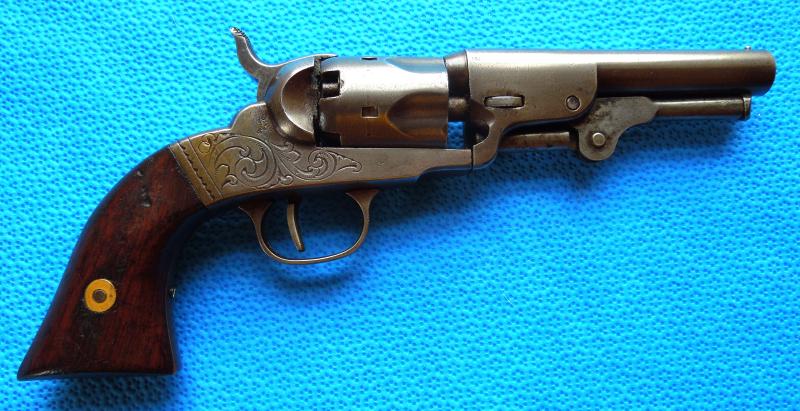
Colt 1862 Police Revolver
Considered by many gun collectors to be the pinnacle of the Colt's factory streamlined revolver design, this five-shot cap and ball weapon has matching serial numbers of 12021 including the cylinder, wedge and spline. Production in the third or fourth quarter of 1862. The five-shot, rebated and fluted cylinder has mellowed to a plumb colour. Cylinder nipples are not chipped nor broken, and the safety pins are not completely hammered down. Hammer lip extremity has some small chips often seen on this revolver but not too bad as can be seen. Cylinder is matched with a 5½" long barrel and a creeper-style loading lever. A clear and sharp "ADDRESS COL SAML COLT NEW YORK US AMERICA" marks the top of the barrel. All barrel gunmetal has mellowed down with some minor evidence of bluing and frame exhibits traces of the original casehardening. Piece shows a pleasing mix of plum with a bright and dusky gray patina overall. The bore is very nice with crisp rifling and no evident pitting, clearly this gun has been looked after.

The standard "COLTS / PATENT" is stamped on the left side of the frame. Revolver is mechanically crisp with strong action and excellent lock up. Grips are of one-piece, varnished walnut, strong and tight and exhibit slight shrinkage. Triggerguard shows faint traces of the original silver-plated wash remaining. The small stamping ".36 CAL" is visible on the brass triggerguard. Frame screws are very good and not messed with.

These revolvers were originally designed for Security agents such as Police and Pinkerton's agents and had a small foresight for rapid drawing and quick close pointing and firing. These are scarce as only 28,000 were manufactured over a 10 year period and many were converted to metallic cartridges so pleasing examples are not easy to find in the UK. This particular revolver issued in 1862 may well have ended up in the hands of a Civil War soldier as many did.
Altogether a pleasing Colt.

Code: 50172Price: 1100.00 GBP


click for more images

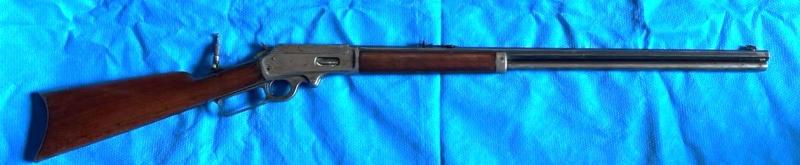
London Small Arms Co Martini Henry BSAC provenance
Now this is an exciting rifle! If you are looking for a standard Martini Henry these are easy to come by and thousands have entered the market from the IMA Nepalese cache where they were stored for over 100 years and had never been pointed or fired in anger. Great examples admittedly but no real history other than the fact that they are Martini’s made in the day.
This however is a little different as it has plenty of history and definitely would have been used in Africa for the purpose it was intended for. If you are looking for history this is it, if you are looking for a rifle with an excellent bore to put onto a FAC this is also it.
Why is this rifle so special? Simple, it is an MkII/1 manufactured by LSA Co (London Small Arms Co) which was only made in limited quantities and LSA is reputed to be one of the better makers, and it ended up being issued to the British South Africa Co who definitely saw action and were the backbone of the infamous or famous Jameson Raid.
The British South Africa Company (BSAC) was a mercantile company incorporated on 29 October 1889 by a royal charter given by Lord Salisbury, the British prime minister, to Cecil Rhodes. The company was modelled on the East India Company and was expected to annex and then administer territory in south-central Africa, to act as a police force, and develop settlements for European settlers. The charter was initially granted for 25 years, and was extended for another 10 in 1915.It was intended that the BSAC would develop the region without significant cost to the British tax payer. It was therefore given the right to create its own political administration supported by a paramilitary force for protection of settlers against local peoples.

Profits from the company, in terms of diamond and gold interests were reinvested in the company to allow it to expand its area of influence. African labour was exploited partially through the application of hut taxes, which required Africans to look for wages.

Mashonaland was invaded by a Pioneer Column in 1830, then the Ndebele in Matabeleland. This formed the proto-colony of Southern Rhodesia (now Zimbabwe). They were stopped from spreading further to the North West by King Leopold’s holdings in Katanga. Instead they appropriated lands which formed Northern Rhodesia (now Zambia). (There were failed attempts to also incorporate Botswana and Mozambique.) The BSAC was involved in the Jameson Raid of December 1895, and they faced a rebellion by the Ndebele in 1896 which required the aid of British to quell. A further rising of Ngoni people in Northern Rhodesia was suppressed in 1897-98.
The Jameson Raid
The bulk of the participants in the Jameson Raid were BSAC troops armed with Martini Rifles and two Maxim machine guns secretly supplied by the British Government. The basic plan was that “Uitlanders” (British immigrants) in Johannesburg would revolt and seize the Boer armoury in Pretoria. Jameson and his force would dash across the border to Johannesburg to "restore order" and with control of Johannesburg would control the gold fields.
However Jameson waited and waited for the insurrection to move but in the meantime differences arose within the Reform Committee and between Johannesburg Uitlander reformers regarding the form of government to be adopted after the coup. At a point, certain reformers contacted Jameson to inform him of the difficulties and advised him to stand down. Jameson, with 600 restless men and other pressures, became frustrated by the delays, and, believing that he could spur the reluctant Johannesburg reformers to act, decided to go ahead. He sent a telegram on 29 December 1895 to Rhodes warning him of his intentions - "Unless I hear definitely to the contrary, shall leave to-morrow evening" - and on the very next day sent a further message "Shall leave to-night for the Transvaal". However the transmission of the first telegram was delayed, so that both arrived at the same time on the morning of the 29 December, and by then Jameson's men had cut the telegraph wires and there was no way of recalling him. On 29 December 1895 Jameson's armed column crossed into the Transvaal and headed for Johannesburg. It was hoped that this would be a 3 day dash to Johannesburg before the Boer commandos could mobilise, and would trigger an uprising by the Uitlanders.
The British Colonial secretary, Joseph Chamberlain, though sympathetic to the ultimate goals of the Raid, was uncomfortable with the timing of the invasion and remarked that "if this succeeds it will ruin me. I'm going up to London to crush it". He swiftly travelled by train to the Colonial Office, ordering Sir Hercules Robinson, Governor-General of the Cape Colony, to repudiate the actions of Jameson and warned Rhodes that the Company's Charter would be in danger if it were discovered the Cape Prime Minister was involved in the Raid. Chamberlain therefore instructed local British representatives to call on British colonists not to offer any aid to the raiders.
Although Jameson's men had cut the telegraph wires to Cape Town, they had failed to cut the telegraph wires to Pretoria (cutting a fence by mistake). Accordingly news of his incursion quickly reached Pretoria and Jameson's armed column was tracked by Transvaal forces from the moment that it crossed the border. The Jameson armed column first encountered resistance very early on 1 January when there was a very brief exchange of fire with a Boer outpost. Around noon the Jameson armed column was around twenty miles further on, at Krugersdorp, where a small force of Boer soldiers had blocked the road to Johannesburg and dug in and prepared defensive positions. Jameson's force spent some hours exchanging fire with the Boers, losing several men and many horses in the skirmish. Towards evening the Jameson armed column withdrew and turned south-east attempting to flank the Boer force. The Boers however tracked the move overnight and on 2 January as the light improved a substantial Boer force with some artillery was waiting for Jameson at Doornkop. The tired Jameson raiders initially exchanged fire with the Boers losing around thirty men before Jameson realized the position was hopeless and surrendered to Commander Piet Cronjé. The raiders were taken to Pretoria and jailed.
The Boer government later handed the men over to the British for trial and the British prisoners were returned to London. A few days after the raid, the Kaiser of Germany sent a telegram congratulating President Kruger and the Transvaal government on their success "without the help of friendly powers", alluding to potential support by Germany. When this was disclosed in the British press, it raised a storm of anti-German feeling. Dr Jameson was lionized by the press and London society, inflamed by anti-Boer and anti-German feeling and in a frenzy of jingoism. Jameson was sentenced to 15 months for leading the raid, which he served in Holloway. The Transvaal government was paid almost £1 million in compensation by the British South Africa Company.
This rifle has an excellent bore as mentioned, it has two very neat arsenal repairs to the fore end around the rear barrel retaining pin but there are no cracks to the solid walnut woodwork. There are some small dents on the right hand of the receiver and the only conclusion I can reach as to how these occurred is that the rifle must have been thrown to the ground at some time. There is a profusion of military stamps and proof marks, evidence of the LSA cartouche remains on the butt and the Receiver is dated 1888. The Knox is stamped BSA Co in a similar manner to a Webley Mk IV revolver I have in my own collection. The Knox is also stamped SX which signifies that the stronger extractor was added as an enhanced modification. There are no sold out of service or DP marks on the rifle. I have added the correct bayonet and scabbard to the rifle which was refinished and issued to the Nepalese but serves to show how intimidating the rifle is when attached!
A real piece of history and if only it could talk!

Code: 50171Price:


click for more images

Tatham Over and Under Officers Flintlock Pistol

This is an exceptional Officers double barrelled overcoat pistol by renowned gun maker Henry Tatham.
Tatham partnered with Durs Egg and his pistols are regarded as some of the finest manufactured of the time.
Manufactured circa 1810-15 this particular pistol has most of the original browning on the octagonal barrel extant and benefits from the original hammers, small parts, and springs. Beautifully detailed engraving with platinum bands and lined touch-holes. The gun features a maker’s plaque “ Tatham London” on the Knox and has “waterproof” pans. The gun is stocked in good quality English walnut finely checkered at the grip with an ornate butt cap. Logs are marked “Tatham”. Barrel length is approximately 3” and bore is 32 bore.
Overall an excellent example of a double barrelled flintlock pistol that has been untouched and is in very pleasing order.

Code: 50169Price: On Request


click for more images

Case pair of Muff Pistols
This is a pair of hidden trigger box lock percussion muff pistols retailed by Wetherhead & Waller.
The later case is in French style and contains a bullet mould, powder flask, cap tin and turnscrew.

The pistols are in absolutely perfect order and cock and lock crisply with very little wear. These have seen very little use.

Code: 50170Price: 850.00 GBP


click for more images

Medieval Signal Mortars
This is an excellent pair of signal mortars which are well cast and date from the 16th Century.
I believe this pair to be German in origin. One measures just over 7" high with a diameter of 2.25" with a 1" bore and the smaller one measures 6" with a 2" diameter and 1" bore.
These were used to signal both time and actions in their day.
Now they make a great conversation piece, and are heavy enough to be used as door stops!
Priced reasonably and an interesting set of very early ordnance.

Code: 50168Price: 425.00 GBP


click for more images

M-1875 Remington Centre fire revolver - Egyptian Contract


This is an extremely fine example of the Remington M-1875 Single Action Army Revolver. The Remington M-1875 is a scarce model and almost the “Cinderella” of the USA revolver world because they are uncommon and when a collector decides he needs (not wants!) one, they are virtually impossible to find in good condition and in this country in obsolete calibre. This model was the first military sized, cartridge revolver to be produced by Remington that was not a conversion of one of their earlier percussion models. The gun was a six shot, single action revolver that competed directly with the Colt Single Action Army. The gun had a fluted cylinder and was produced in three centre fire calibres, .44 Remington, .44 WCF (44-40) and eventually .45 Colt. The majority of the revolvers produced had 7 ½” barrels, although a few were produced with 5 ¾” barrels and are considered very scarce today. The revolvers were produced with both blued and nickel finishes. Oil finished, two-piece walnut grips were standard, but other options were available on special order. Remington produced the M-1875 revolver from 1875 until 1889, with a total production of only between 25,000 and 30,000; a very small production run when compared with Colt’s M-1873 Single Action Army.

Remington entered the big-bore military cartridge handgun market with an initial order for 10,000 pieces from the Egyptian government. These guns were all chambered for Remington’s new .44 Remington CF cartridges, a short lived cartridge that was very close to the .44 Colt in dimensions and power and was discontinued in 1895. Later Remington M-1875’s would be produced in the more successful .44-40 and .5 Colt calibres. The Egyptian contract guns were inspected like US military arms, and carried a * mark on the left side of the barrel, forward of the frame and an R sub-inspectors mark on the cylinder and the frame between the cylinder & the barrel. The left grip was also with either an FR or JWR cartouche. Unfortunately for Remington, the big Egyptian order did not pan out and few (if any) of the guns were actually delivered to the Egyptians. The problems arose over Egypt’s failure to pay large balances due on earlier Remington Rolling Block military rifle orders. The end result was that the production of the Egyptian contract guns ended prematurely and the existing guns were apparently sold on the open market to allow Remington to recoup their money. According to most references, these Egyptian contract marked revolvers are quite scarce and demand a significant premium on the collector market today. Despite the overwhelming competition from Colt, Remington did manage to receive a small contract form the US Government in 1883 to deliver 639 nickel plated M-1875’s to the Department of the Interior for use by the Indian Police. Among the luminaries of the era who used the Remington 1875 was infamous outlaw Frank James, who preferred to carry one in.44-40 (the same calibre as his Winchester rifle), noting that it was important to “not confuse your ammunition in a hot fight”. While the Remington M-1875 never achieved the success or sales figures of the Colt, it was none the less one of the important revolvers to see use during the taming of the American West. To this day, its distinctive rib under the barrel brings to mind the Remington percussion army revolvers that it was based upon and makes the gun instantly identifiable in period images.


This example of a Remington M-1875 “Army” Revolver is in very fine condition and is one of the scarce Egyptian Contract guns. The gun is faintly marked with a JWR within an oval cartouche on the left grip, and has the sub-inspection “Star” mark on the barrel and an R on the cylinder. The gun is clearly marked on the top of the barrel in a single line: E. REMINGTON & SONS, ILION, N.Y. U.S.A. Otherwise the gun is unmarked externally. The serial number 7274 is present on the edge of the left grip frame underneath the grips, on the loading gate and pencilled on both grips. The gun is crisp with great deal of blueing remaining and no rust. The action is perfect and the bore and chambers are mint. It would be difficult to improve on this revolver and would make a fine addition to an advanced collection.

Code: 50167Price: 6500.00 GBP


click for more images

Remington Model 1879 Rolling Block Rifle
Another great Argentine rolling block , mint bore and crisp mechanics from the reneged Argentine contract. Arsenal refinished as all of the hoard was and a good example to enhance any collection, there is one small good arsenal repair to the wood but no cracks or other defects. Bought at the right price so less expensive than my other example.

Code: 50166Price: 750.00 GBP


click for more images

Rare Adams 38 Bore Mould
The tailed Adams moulds were short lived as the patented rammer systems made them obsolete. This particular mould is for the massive 38 bore ( .50") calibre large frame revolvers which are uncommon if not rare. The mould still casts perfectly but has seen "honest travel" and has no doubt made hundreds of bullets.

Code: 50165Price: 575.00 GBP


click for more images

Manhattan Series IV revolver
This is a good .36 calibre Manhattan Series IV Navy.
The revolver itself is all matching and has a tight lock up with 10 cylinder safety notches which allowed the revolver to be carried with the hammer dropped between the nipples, a feature unique to Manhattan.
Manhattan was a serious competitor to Colt and many people consider them better made than Colt.
This one has a six and a half inch barrel, crisp address and good grips. There is no cylinder scene and it has been speculated that this was removed if the revolver had been used in a military capacity. Manhattan firearms went out of business within a couple of years of the end of the Civil War and are scarcer than Colt and Remington.

Code: 50163Price:


click for more images

Extraordinary Civil War Sharpshooters Spectacles
This is quite an extraordinary item insofar as it demonstrates a degree of technical competence way ahead of its time and is a fragile artefact that has survived.
These glasses make a remarkable difference to your sight picture in all degrees of light and were used by sharpshooters to improve their performance. These spectacles were reputed to be found in the Fredericksburg area of Virginia and handed down for generations. Fredericksburg was an area in which some of the most savage battles of the American Civil War were fought with casualties running into the tens of thousands.
This is a very personal and poignant item that would have been used by a "sharpshooter" or sniper who would already have some renown and be issued with a special rifle. I doubt if I will ever see the like again.

Code: 50162Price:

Website designed & maintained by Concept500